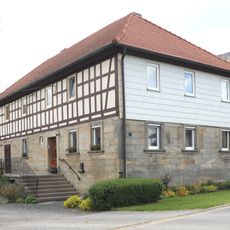
Langheim Abbey, Cistercian monastery in Klosterlangheim, Bavaria, Germany.
Langheim Abbey is a former Cistercian monastery in Klosterlangheim, part of Lichtenfels in Upper Franconia. The surviving two-storey buildings, rebuilt in Baroque style between 1680 and 1792 under abbots including Stephan Mösinger, have light stone facades, red-tiled roofs and a central gable with relief carvings and a small round window. Three large arched openings and an arched passage pierce the ground floor; a hedge and gravel path run along the front.
The monastery was founded in 1132 and grew into a major landholder and administrative center through support from bishops and nobility. Swedish forces inflicted severe damage during the Thirty Years' War, a blow from which the institution never fully recovered.
The abbey's monks included the mathematician and astronomer Mauritius Knauer, abbot from 1649 to 1664, who published works on the natural sciences and the ascetical "Tuba Coeli". The most prolific author was Joachim Jaeck, who after secularisation published his research on the history of Bamberg and the surrounding country.
The abbey is located in the center of Klosterlangheim and is easily accessible on foot. Some buildings are viewable from the outside, while interior access may vary depending on opening hours and religious services.
The oldest surviving monastic building is the former Katharinenkapelle, built around 1220 as a gate chapel near the north entrance. After secularisation it served as a barn, and its Romanesque portal was sold in 1908; it is now in the Berlin sculpture collection.
The community of curious travelers
AroundUs brings together thousands of curated places, local tips, and hidden gems, enriched daily by 94,367 contributors worldwide.