European Archaeological Park of Bliesbruck-Reinheim, Archaeological park and open-air museum in Bliesbruck and Reinheim, France and Germany
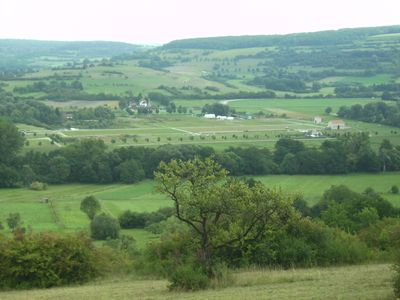
The European Archaeological Park of Bliesbruck-Reinheim covers 70 hectares on both banks of the Blies, straddling the French-German border between Bliesbruck and Reinheim. Its main excavated remains are a Gallo-Roman small town (vicus) with a bath complex and an artisans' quarter, a 7-hectare Roman palace villa, and the reconstructed burial mounds of a Celtic princess. A protective building covers the baths, and the CREX centre holds the finds.
Archaeological digs uncovered a Celtic necropolis from around 370 BC, including the burial of a princess with bronze mirrors and precious ornaments. The Romans later settled in the same location and developed a thriving trade center with craft shops and bath facilities.
The thermal baths served as social gathering places where people from the region came together to bathe, conduct business, and maintain community bonds. Visitors can still observe the layout of these spaces and understand their importance in daily life.
The site is open to visitors from mid-March through late October and offers guided tours in French, German, and English. Visits include access to reconstructed buildings and exhibitions that illustrate daily life during ancient times.
The park's name honours Jean Schaub of Sarreguemines, who pushed for the cross-border project and after whom the Maison Jean Schaub museum is named. The archaeologist Jean-Claude Golvin drew a series of reconstruction views of the Roman settlement. The German side was long directed by Florian Sărăţeanu-Müller, followed by Michael Ecker, with Andreas Stinsky as museum director since 2012.
The community of curious travelers
AroundUs brings together thousands of curated places, local tips, and hidden gems, enriched daily by 92,856 contributors worldwide.