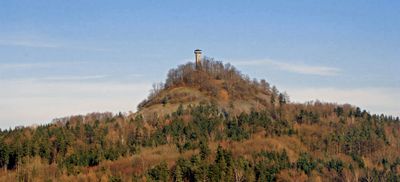
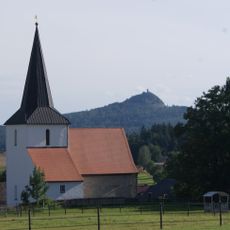
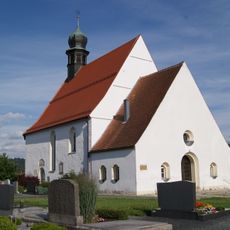
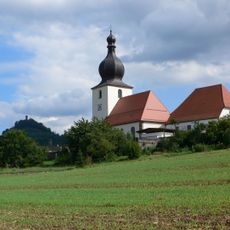
Rauher Kulm, Volcanic summit near Neustadt am Kulm, Germany.
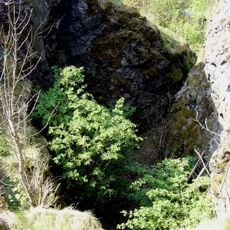
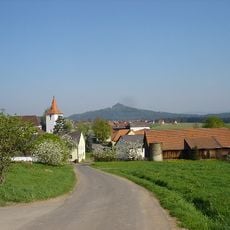
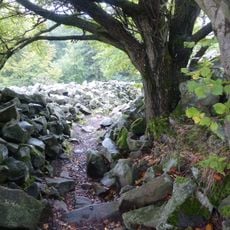
Rauher Kulm is a 681-metre basalt cone near Neustadt am Kulm, 23 km southeast of Bayreuth. Its magma solidified about 21 million years ago roughly 50 km below the surface and never erupted; erosion later exposed the basalt columns, which broke into a blockfield around the summit. A 25-metre steel tower with larch cladding, reached by 110 steps, stands on top.
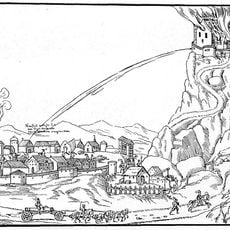
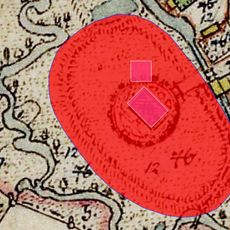
The summit was settled in the Celtic period around 500 BC and fortified again in the early Middle Ages, when Slavs lived around the mountain; a small early medieval mission cross (8th–10th century) was found there. From the 8th century a large castle complex incorporated stones of earlier ramparts, reinforced during the 10th-century Hungarian invasions. In 1281 Burgrave Frederick III of Nuremberg acquired the hilltop castle with its dependent villages from the Landgraves of Leuchtenberg; Nuremberg troops destroyed it after a long siege in the Second Margrave War, as they did the castle on the neighbouring Kleiner Kulm.
The summit's towers have a documented sequence: Nicolaus Apel built a wooden tower in 1807 with a gilded sun above a hall, hence the name Sonnentempel; it stood until 1895. A fourth tower burned down on 30 June 1984 after arson, and the present 110-step, 85-tonne tower was inaugurated on 1 July 1988 under mayor Karl Pühl.
The ascent follows a rocky path from the sports park parking area, taking approximately 30 to 40 minutes to reach the top. The terrain is uneven and requires sturdy footwear, particularly after rain when the rock blocks can become slippery.
The mountain formed from an ancient volcanic pipe that still shapes the blockfields and rock formations today. This geological structure makes the peak a rare example of volcanic activity in the region and explains its protected status.
The community of curious travelers
AroundUs brings together thousands of curated places, local tips, and hidden gems, enriched daily by 93,368 contributors worldwide.