Trogenbachbrücke, Railway bridge in Ludwigsstadt, Germany.
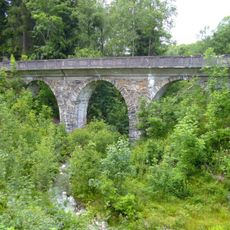
The Trogenbachbrücke is a 200-metre railway bridge over the Trogenbach valley in Ludwigsstadt, carrying the Hochstadt-Marktzeuln–Probstzella line. It combines four masonry stone arches of 14.5 m span on the south slope with three 32-metre steel truss girders on two masonry piers, plus one more arch on the north slope. Its greatest height above the valley floor is 26 metres.
The Trogenbachbrücke was built between 1883 and 1885 to link the existing Bavarian and Thuringian rail networks via a continuous line from Stockheim through Ludwigsstadt and Probstzella to Eichicht. Because the site was poorly connected, it was largely hand-built from slate quarried at nearby Lauenstein rather than as a steel truss, at a total cost of 309,000 marks. It opened on 1 October 1885 with a single track; the second track followed on 22 November 1890.
The bridge is a Bavarian architectural heritage monument on the Hochstadt-Marktzeuln–Probstzella line. Its three steel trusses were replaced by fish-belly girders between early 1923 and 12 May 1924, and in autumn 1935 the two masonry piers were encased in concrete ahead of electrification. Look for the slate masonry from Lauenstein, visible in the four arches on the south slope.
Visitors can view the bridge from several pathways around the area and study its construction details up close. Since trains regularly use the line, it is important to stay clear of the tracks and observe from safe viewing areas.
In 1945, near the end of the Second World War, the bridge was to be blown up; the town's second mayor prevented it. The structure survived and still carries the Hochstadt-Marktzeuln–Probstzella line today.
The community of curious travelers
AroundUs brings together thousands of curated places, local tips, and hidden gems, enriched daily by 94,357 contributors worldwide.