Rosenberg Fortress, Medieval fortress in Kronach, Germany
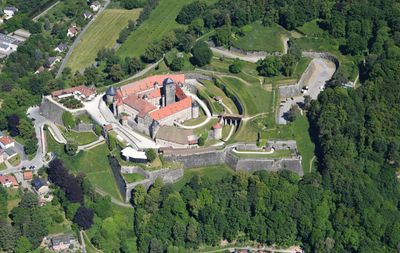
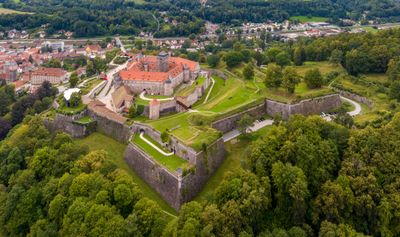
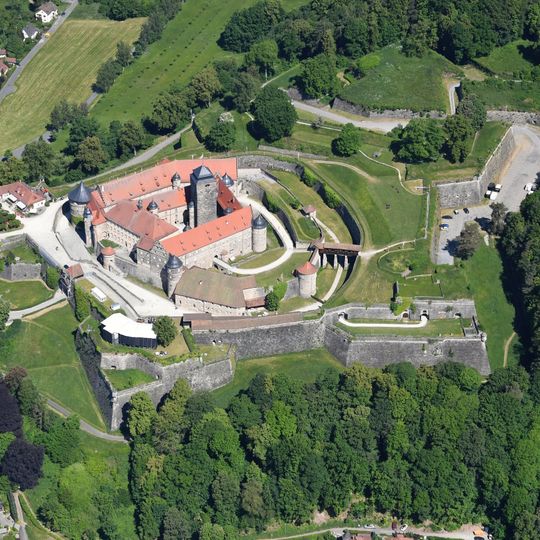
Rosenberg Fortress sits on a hilltop overlooking Kronach with five large bastions enclosing an expansive fortified area. Inside, visitors find preserved rooms, dungeons, and defensive passages that span several centuries of construction.
Rosenberg Fortress is first recorded by name in a 1249 letter of Pope Innocent IV, which mentions it in a dispute over the pledged town and castle; a 1260 treaty calls it "castrum in Ronssenberg". Around 1130, Otto of Bamberg is said to have built a stone house and tower at Kronach. Prince-Bishop Philipp von Henneberg raised the surviving second curtain wall at the end of the 15th century, and after the Second Margrave War a third ring of four earth-and-timber bastions was added.
The name Rosenberg comes from the hill itself, and the fortress was first recorded under it in a 1249 letter of Pope Innocent IV. The Prince-Bishops of Bamberg long used Kronach as a refuge: Christoph Franz von Buseck, the last of them, withdrew here before his deposition in 1802. Since 1983 the plastered Kommandantenbau has housed museum rooms.
The fortress stands on the 378-metre Rosenberg hill above Kronach, where the Haßlach, Kronach and Rodach valleys meet. The south side falls steeply, so the outer walls rise up to 25 metres there. The northern ridge was the main attack side and carries the strongest fortifications; allow time to walk the three concentric rings.
The 38-metre bergfried has its entrance about twelve metres up, reachable only by ladder until a slim stair tower was added in the 16th century. Its original Welsh hood and the watchman's room below were removed by the Bavarian army in the 19th century and replaced by today's roof.
The community of curious travelers
AroundUs brings together thousands of curated places, local tips, and hidden gems, enriched daily by 93,989 contributors worldwide.