Großsteingrab Drosa, Megalithic passage grave in Osternienburger Land, Germany
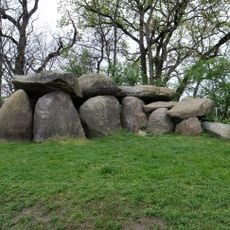
Großsteingrab Drosa is a late Neolithic passage grave of the Walternienburg-Bernburg culture, now reduced to six supporting stones and one capstone. The trapezoidal chamber runs east-southeast to west-northwest, at least 9.2 m long, narrowing from 2.30 m to 1.25 m in width. The surviving capstone at the west-northwest end measures 4.20 m by 3.33 m and is 0.75 m thick.
The tomb belongs to the late Neolithic Walternienburg-Bernburg culture, not the early Neolithic. It was uncovered around 1700 and named "Teufelskeller". In 1903 land consolidation began its dismantling, and in spring 1904 seventy cartloads of the mound were removed. From 13 to 26 April 1904 the Köthen Historical Society excavated it under Otto Gorges.
The tomb is also called "Teufelskeller" (Devil's Cellar), a name recorded around 1700 when the megalithic structure was uncovered. The name is the only folk tradition the sources document; the site lies in open fields north of Drosa, reached by a footpath from Diebziger Weg.
The tomb lies north of Drosa in open fields, reached on foot from Diebziger Weg; the path is unpaved and the ground around the stones uneven. Only six wall stones and one capstone remain, so the chamber outline is best read from the surviving stones and the low mound line. Nearby megalithic tombs include Wulfen, 1.7 km southeast.
The tomb was already opened around 1700 and named "Teufelskeller". In 1904, Otto Gorges of the Köthen Historical Society excavated it; the chamber held about 35 vessels, including small cups decorated with lines, dots, zigzags and herringbone patterns.
The community of curious travelers
AroundUs brings together thousands of curated places, local tips, and hidden gems, enriched daily by 94,637 contributors worldwide.