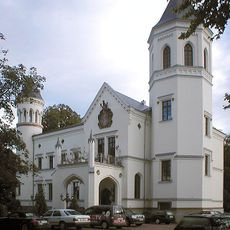
Schloss Kittendorf, Gothic Revival castle in Kittendorf, Germany.
Schloss Kittendorf is a two-storey Gothic Revival manor house built from 1848 to 1853 to a design by Friedrich Hitzig, modelled on Babelsberg Palace. Its main block runs southwest to northeast, with a five-storey polygonal tower at the east corner, a portal with a projecting balcony on the northeast front, and a long terrace along the southeast side facing the park. The interior preserves stucco work by Friedrich Wilhelm Dankberg and now holds 25 hotel rooms and suites.
The castle was built between 1848 and 1853 for Hans Friedrich von Oertzen, designed by Friedrich Hitzig, who had trained under Berlin architect Karl Friedrich Schinkel. After a turbulent 20th century that included use during the East German period, the building was later restored and reopened as a hotel.
The name Kittendorf refers to the village where the castle stands and is closely tied to the von Oertzen family, who shaped the local area for generations. Guests staying in the hotel today can walk through rooms that once served the social life of the landowning class in rural Mecklenburg.
The castle sits in open countryside and is easiest to reach by car, as the nearest towns are a short drive away. Both hotel guests and day visitors can explore the surrounding parkland on foot.
The park's designer is not documented: sources only presume that Peter Joseph Lenné laid it out around the time the manor was built. At its largest the English landscape park covered 110 hectares, making it one of Mecklenburg's largest; today it measures about 20 hectares. Lenné is said to have dammed the Peene into a pond with two islands and routed the stream through the grounds in a romantic manner.
The community of curious travelers
AroundUs brings together thousands of curated places, local tips, and hidden gems, enriched daily by 94,344 contributors worldwide.