Pfieffetalbrücke, Railway bridge in Spangenberg, Germany
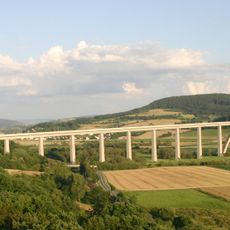
The Pfieffetalbrücke is a railway bridge made of prestressed concrete that crosses a valley as part of the rail line between Hannover and Würzburg. The structure uses modern concrete engineering to carry trains safely above the valley floor.
The Pfieffetalbrücke was built between 1987 and 1989 for the Deutsche Bundesbahn as part of the Hannover–Würzburg high-speed line, in planning section 13 of the line's middle section. The Wetzlar firm that had just built the neighbouring Mülmischtalbrücke also erected this bridge, modelling the piers and the A-frame on that earlier structure. Costs were put at 38.6 million D-Mark.
The bridge's pillars and A-frame were shaped by the Wetzlar firm that had just built the neighbouring Mülmischtalbrücke, using the same special proposal; critics call the pillar shaping unnecessary. Since the second half of 2019, one track's rails have been painted white over a thousand metres, with sensors comparing steel temperatures between the painted and unpainted track.
The bridge crosses the Pfieffe valley and the B 487 between Adelshausen and Mörshausen, both parts of Spangenberg. The best ground-level views are from the B 487 and from paths in the valley, where the 61 m maximum height and the 116 m span of the A-frame become visible. The structure itself carries the Hannover–Würzburg high-speed line and is not open to visitors.
The bridge rests on large bored piles, 1.5 m in diameter, founded on Buntsandstein; twelve piles usually sit under each 11.2 m × 11.2 m × 2.3 m pile cap. Its arched A-frame has a 116 m span, twice that of the normal fields, and stands off-centre because of the valley's shape, acting as the bridge's fixed point.
The community of curious travelers
AroundUs brings together thousands of curated places, local tips, and hidden gems, enriched daily by 94,010 contributors worldwide.