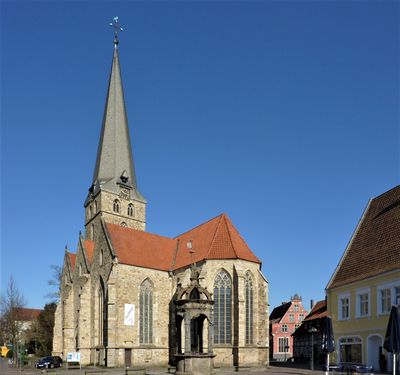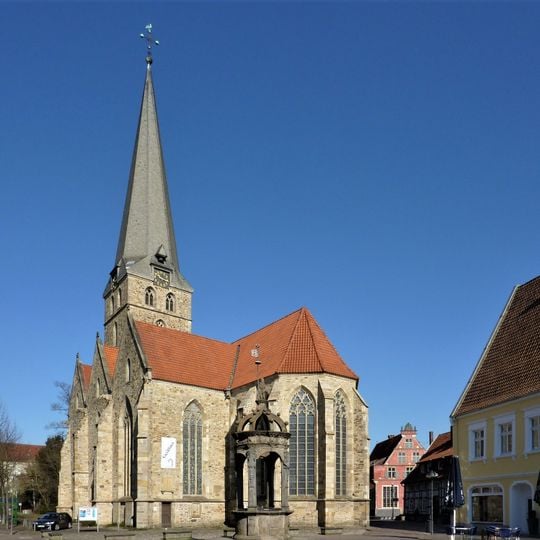
St. Johannis, Gothic church in Herford, Germany.
St. Johannis is a Gothic church built in stages from around 1250 to 1370 as a Westphalian square, with a nave of two western bays and a choir extended eastward around 1320. Its tower, rebuilt between 1906 and 1910, stands 71 metres high, the tallest in Herford. The interior holds 16th- and 17th-century furnishings, including carved guild chairs and a 1602 pulpit donated by mayor Daniel Pöppelmann.
St. Johannis was founded in the early 13th century as a religious building during the medieval period of North Rhine-Westphalia. The construction shows how Gothic architectural techniques and forms became established in this region over time.
The church keeps the carved wooden seats of the Neustadt craft guilds, and its baroque pulpit of 1602 was donated by mayor Daniel Pöppelmann, ancestor of the Dresden architect Matthäus Daniel Pöppelmann. The 16th-century altar painting of the Last Supper shows a figure pouring wine, probably the donor. In the sacristy a Gothic cupboard held the Dionysius treasure for over 450 years.
The church stands in Herford's Neustadt, distinct from the neighbouring Catholic St. Johannes Baptist. Since 2008 it has not been heated for cost reasons, so the interior stays cold outside summer. The tower, at 71 m the tallest in Herford, was rebuilt between 1906 and 1910 on new foundations.
The tower that visitors see today is not the medieval original: it was taken down to its foundations and rebuilt between 1906 and 1910, reusing the old material but with one storey less, leaving it 71 metres tall. Its predecessor had leaned so far that it was known as the "leaning tower of Herford".
The community of curious travelers
AroundUs brings together thousands of curated places, local tips, and hidden gems, enriched daily by 93,972 contributors worldwide.