Jesuitenkirche, Baroque church in Landshut, Germany.
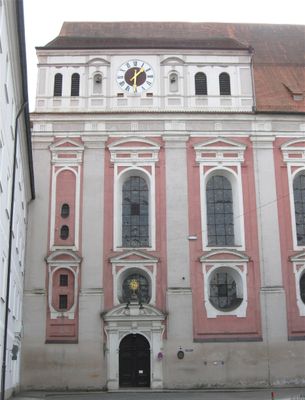
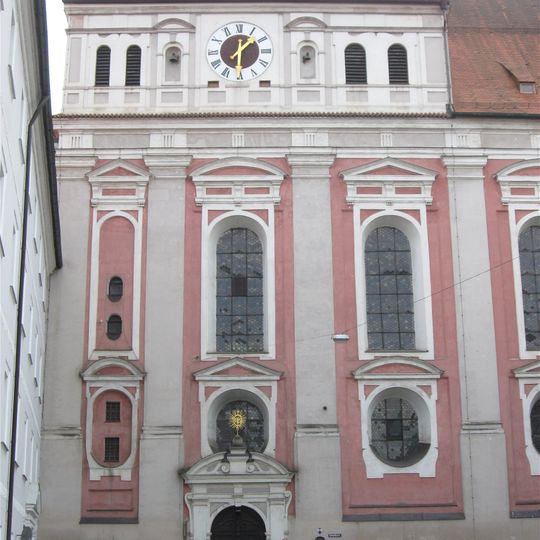
St. Ignatius is a wall-pillar church with side chapels, oriented unusually to the west. Its single nave has four full bays and a half bay, followed by a three-bay choir ending in a semicircular apse. The north facade toward Neustadt is the only decorated side, with flat pilasters and alternating triangular and segmental pediments; a planned tower was never built.
Countess Magdalena von Haunsperg bequeathed 56,000 guilders in 1627/28 to found a Jesuit college in Bavaria; Duke Maximilian I chose Landshut. The foundation stone was laid on 31 July 1631 by Freising Prince-Bishop Veit Adam von Gepeckh. Swedish reprisals in 1632 and 1634 slowed work until an alder-pile foundation was laid in 1637; the church was consecrated on 25 November 1640.
The church is dedicated to Ignatius of Loyola, whose feast day is 31 July. Wessobrunn master Matthias Schmuzer stuccoed the nave and front side chapels in 1640/41; the choir and remaining chapels received their stucco in the 1660s, when several altars including the high altar were acquired.
The church closes the Neustadt at its upper end, where the street meets the Hofberg; the north facade is the only side visible from the street. The building is a side church of the St. Martin parish and was closed for 18 years; it reopened in June 2026 after foundation work and interior renovation.
The church has no tower: money ran out and only the foundation walls of the planned tower were ever built. A 1723 engraving by Michael Wening still shows a roof turret with a pointed cap, which no longer exists today.
The community of curious travelers
AroundUs brings together thousands of curated places, local tips, and hidden gems, enriched daily by 94,062 contributors worldwide.