Albertbrücke, Stone bridge in Johannstadt, Dresden, Germany.
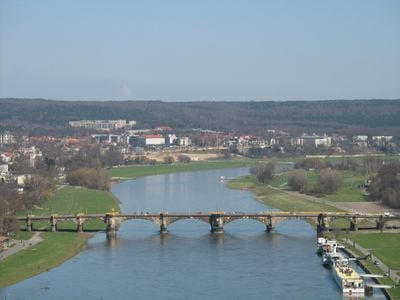
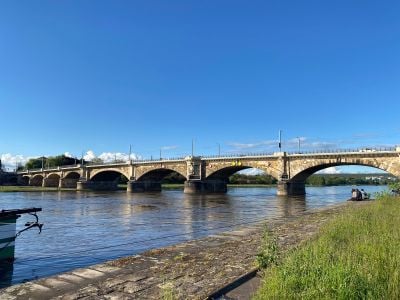
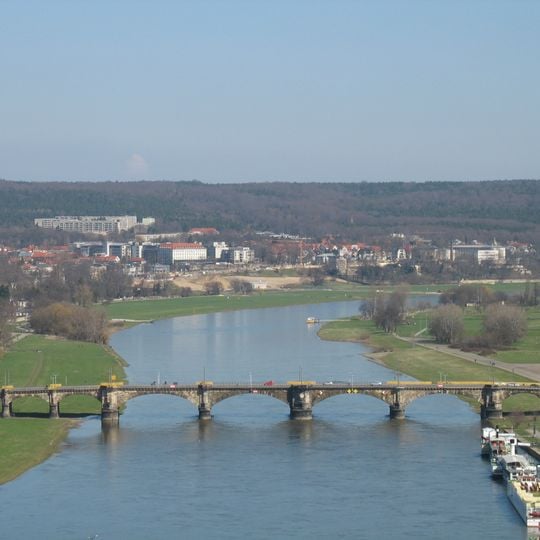
The Albertbrücke is a 316-metre stone bridge over the Elbe, linking the Sachsenplatz on the south bank with the Rosa-Luxemburg-Platz on the north. Its 14 sandstone arches are arranged symmetrically around a 7.5-metre central pier, and the four river openings have a clear span of 31 metres. The central pier carries a Carrara marble relief portrait of King Albert on the upstream side and the Dresden coat of arms on the downstream side.
Construction began on 14 June 1875 under city chief engineer Carl Mank, and the bridge opened on 19 November 1877 as the König-Albert-Brücke. On 7 May 1945, three arches on each side were blown up; rebuilding with clad reinforced-concrete arches was completed in July 1946. It was then renamed Brücke der Einheit, and the original name was restored after German reunification on 3 October 1990.
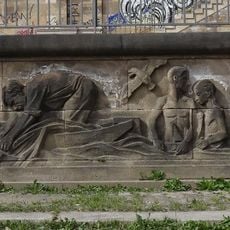
The central pier carries two Carrara marble reliefs: a portrait of King Albert on the upstream side and Dresden's coat of arms on the downstream side. The bridge was called Brücke der Einheit from the GDR era until German reunification on 3 October 1990, when its original name was restored.
The bridge experiences heavy daily traffic with enough space for pedestrians and vehicles on separate paths. Visitors should know that it can become crowded during peak hours, so walking during quieter times offers a better experience.
The central pier carries a Carrara marble relief portrait of King Albert on the upstream side and Dresden's coat of arms on the downstream side. The bridge was called Brücke der Einheit from the postwar years until German reunification on 3 October 1990, when its original name returned.
The community of curious travelers
AroundUs brings together thousands of curated places, local tips, and hidden gems, enriched daily by 93,897 contributors worldwide.