Haubenschloß, Architectural heritage monument and archaeological site in Kempten, Germany.
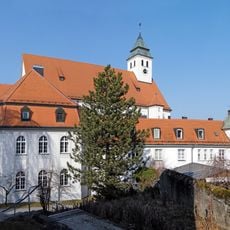
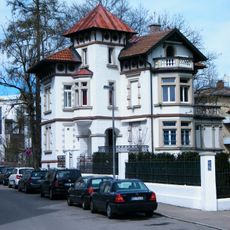
Haubenschloß is a listed rectangular building at Haubenschloßstraße 37 in Kempten, erected largely in 1601 and 1632 for the patrician Tobias Schmelz on the basis of the Gothic castle Anwanden. Two small double turrets with saddle roofs stand on the west side; to the east is a steep 18th-century gable with volutes.
The Haubenschloß stands on the site of the Gothic castle Anwanden, shown on Kempten's oldest printed city view of 1569 as a fortress with two towers. In 1600 the patrician Tobias Schmelz negotiated with the previous owner Matthäus Gufer over the Anwanden estate, and the buildings were largely rebuilt in 1601 and 1632. A 1604 reverse document records Schmelz's agreement with Prince-Abbot Johann Adam Renner von Allmendingen concerning the enlargement of the Anwanden courtyard.
The name comes from the artist Hieronymus Hau, who owned the building in the 18th century; in local speech "Hau" became "Haubenschloß". From 1918 to 1955 the Allgäu dialect poet Else Eberhard-Schobacher lived in one of the tower flats. Since 1886 the house has served as an inn.
The Haubenschloß stands at Haubenschloßstraße 37 in Kempten, with the Allgäu-Gymnasium and the Haubenschloßschule nearby as orientation points. The two double turrets face west, each under a saddle roof, while the steep 18th-century gable with volutes faces east. Since 1886 the building has served as an inn, so visitors should expect a working restaurant rather than an open monument interior.
The two small twin turrets stand on the west side, each topped by its own gable roof, while a steep 18th-century gable with volutes faces east. From 1918 to 1955 the Allgäu dialect poet Else Eberhard-Schobacher lived in one of the turret apartments.
The community of curious travelers
AroundUs brings together thousands of curated places, local tips, and hidden gems, enriched daily by 93,841 contributors worldwide.