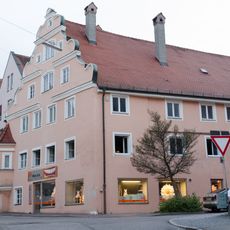
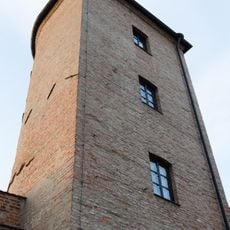
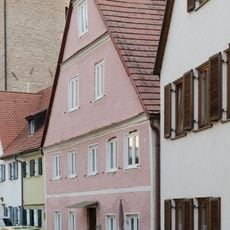
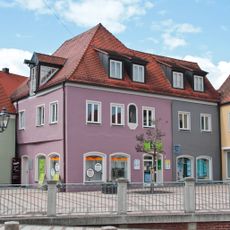
Benediktinerkloster Heilig Kreuz, Benedictine monastery in Donauwörth, Germany.
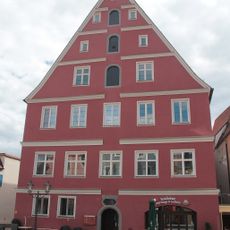
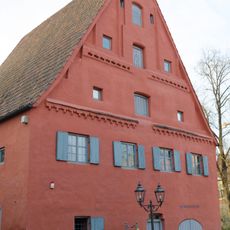
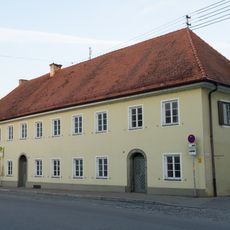
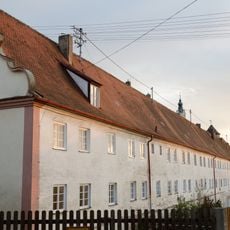
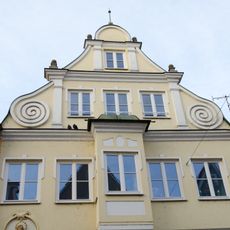
Benediktinerkloster Heilig Kreuz is a former Benedictine abbey on the highest point inside Donauwörth's town walls. The west wing was built from 1680; Valerian Brenner added the south and east wings in 1696/1700, incorporating the medieval cloister. The abbey church, built by Joseph Schmuzer, has stucco by Franz Schmuzer (1719) and a high altar of 1729.
The monastery was founded in 1040 as a convent for women and received a fragment of the True Cross from Constantinople as a founding gift. This relic shaped its identity until today.
The monastery church keeps its function as the parish church of Heilig-Kreuz and as a pilgrimage site. In the crypt lies Duchess Maria of Brabant, beheaded in 1256 on the order of her husband Louis the Strict; her epitaph slab is surrounded by a wrought-iron grille donated by Prince Regent Luitpold of Bavaria, with memorial plaques for her ladies-in-waiting set into the floor.
The former abbey church is now the parish church of Heilig-Kreuz and also serves as a pilgrimage church, so it stays in liturgical use. The monastery buildings themselves are occupied by the Herz-Jesu-Missionare, who have lived there since 1935, and are not a public museum. The complex sits at the highest point inside Donauwörth's old wall ring, at the western edge of the centre.
Napoleon Bonaparte stayed in the monastery rooms in 1809 during the Fifth Coalition War and issued his first campaign orders from there. This historical event connects the religious building with a moment in European military history.
The community of curious travelers
AroundUs brings together thousands of curated places, local tips, and hidden gems, enriched daily by 93,389 contributors worldwide.