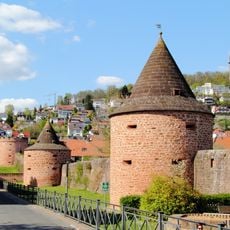
Untertor, Medieval city gate in Büdingen, Germany
The Untertor is a double-tower gate forming the western entrance to Büdingen's old town. Its two round towers, 3.90 m across at the middle level, have walls 1.60 m thick below and 1.20 m above, with three firing slits per floor. The parapets carry fish-bladder tracery, a lion-shaped waterspout, and a bay window with the alliance coat of arms of Ludwig II of Ysenburg and Maria of Nassau.
Built in 1503 as part of Count Ludwig II's fortification strategy, the gate served as a key defensive element for the town. A drawbridge spanning the moat enhanced its defensive capabilities and controlled entry into the city.
The gate became known as the Jerusalem Gate when Protestant refugees arriving in 1521 called it their Jerusalem while seeking shelter in the town. The name still reflects this period of religious sanctuary and the gateway's role in offering protection to those fleeing persecution.
The gate forms the western entrance to the old town, so it is reached on foot from the surrounding streets. The drawbridge over the former moat, uncovered in the 2003 restoration, can be seen in front of the gate. The Sandrosen Museum occupies the two towers.
Each tower's middle storey measures 3.90 metres across, with walls from 1.60 metres thick at the base to 1.20 metres at the top. The slits sit only about one metre above each floor, so the marksmen likely fired from chairs or stools. The wide outer opening gave a horizontal field of fire of nearly 90 degrees.
The community of curious travelers
AroundUs brings together thousands of curated places, local tips, and hidden gems, enriched daily by 93,903 contributors worldwide.