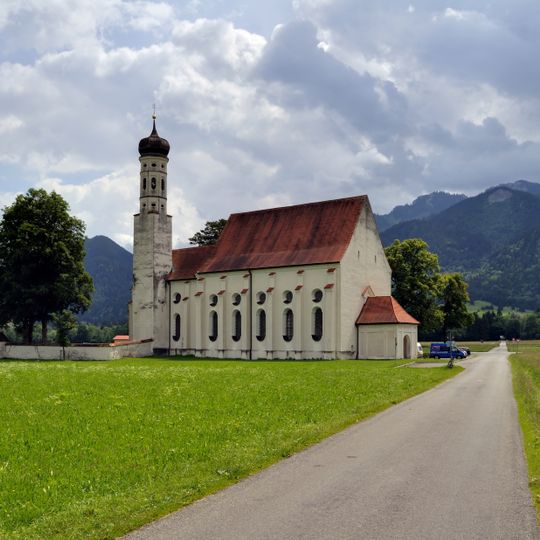
St. Coloman, Baroque Catholic pilgrimage church in Schwangau, Germany.
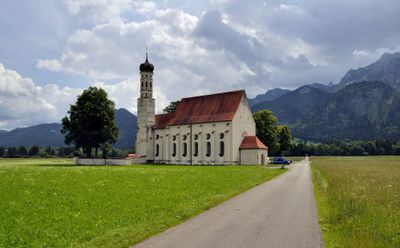
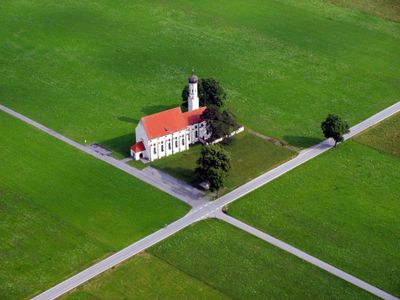
St. Coloman is a baroque pilgrimage church standing in open fields east of Schwangau, its white walls and red saddle roof topped by a square tower on the west side of the long choir, crowned with an onion dome. Stepped buttresses and two rows of windows divide the exterior, and a low wall of 1684 encloses the former plague cemetery.
A small field chapel, probably from the 15th century, first stood here; it became a pilgrimage site in that same century. The Füssen mason Hieronymus Vogler began the present church in 1673, following a 1671 design by the Wessobrunn stuccoist Johann Schmuzer, and work finished in 1678. The west tower was added in 1682, the porch in 1714, and consecration followed in 1685.
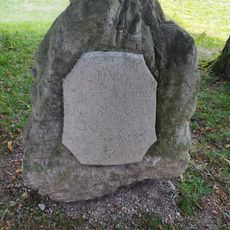
Pilgrimage to the church and its predecessor chapel is documented since the 15th century and peaked in the 17th and 18th centuries. Each October the Colomansfest is still held, with the Colomansritt, a horse ride in honour of the saint. The church is named after Saint Coloman, an Irish pilgrim said to have rested here in summer 1012.
The church stands on open field east of Schwangau on the Colomanstraße, which branches off the B17 a few hundred metres east and runs south toward Hohenschwangau. The building is visible from afar; the entrance porch added in 1714 faces the road. A low wall (1684) encloses the former plague cemetery east of the church, with a small round turret at its north-east corner.
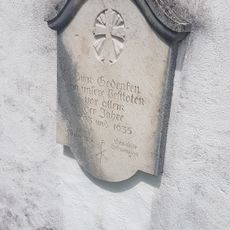
The church stands on the site where the Irish pilgrim Coloman is said to have rested in summer 1012 on his way to the Holy Land. The low wall around the church encloses the former plague cemetery of 1635/1636, and a small round turret guards its northeast corner.
The community of curious travelers
AroundUs brings together thousands of curated places, local tips, and hidden gems, enriched daily by 92,929 contributors worldwide.