Georgenstein, Natural boulder in Grünwalder Forst, Germany
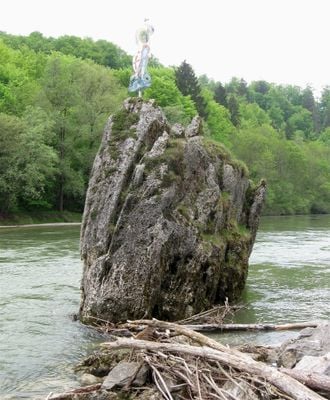
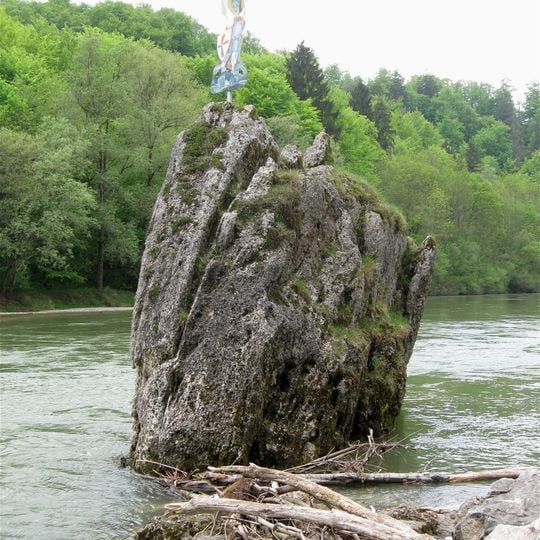
Georgenstein is a grey Nagelfluh conglomerate block, 8.4 m long and 4 m wide, rising 5.3 m above the Isar at river kilometre 163.2. Its base is underwater, its flanks carry moss and its flatter top grasses; a painted tin figure of Saint George stands on a thin rod at the summit. A 25 m artificial dam links it to the eastern bank.
The block is a piece of Altpleistozän deck gravel that broke off the eastern Isar slope and slid onto Miocene tertiary layers into the riverbed; it is Nagelfluh conglomerate. The Via Julia, the Roman road from Günzburg via Augsburg to Salzburg, crossed the Isar here, and cut square holes in the rock are thought to have held bridge beams. From the 12th century until the early 20th, raftsmen feared the rapids here; in 1805 raftsman Georg Müller struck the block, called on his patron saint and afterwards had the image of St George mounted on top, giving the rock its name.
The name comes from the raftsman Georg Müller, who struck the rock with his raft in 1805, called on his patron saint and, after being rescued, had a painted tin figure of Saint George mounted on top. The figure still stands there today.
The rock is best reached on foot via hiking trails that wind through Grünwalder Forst. Wear sturdy shoes, as some paths are uneven and run alongside the river.
The rock is a block of Nagelfluh, an old-pleistocene conglomerate that broke off the eastern Isar slope and slid onto miocene tertiary layers in the riverbed. It is listed by the Bavarian State Office for the Environment as geotope 184R004. Around 160 metres downstream stands the St.-Michael-Stein, formerly called Kleiner Heiner.
The community of curious travelers
AroundUs brings together thousands of curated places, local tips, and hidden gems, enriched daily by 94,484 contributors worldwide.