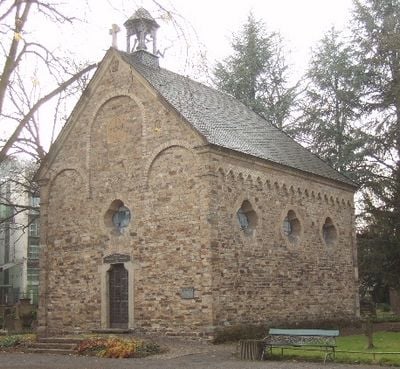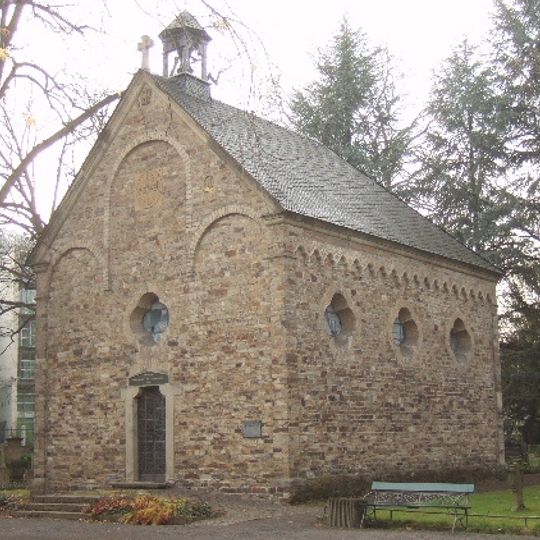
Georgskapelle, 13th-century Romanesque chapel in Alter Friedhof, Germany
Georgskapelle is a small Romanesque chapel with early Gothic elements, built around 1230 as part of the Ramersdorf Teutonic Order commandery. Its thick stone walls and simple window openings survive, but the medieval vault and wall paintings were destroyed when the building was moved to Bonn's Old Cemetery in 1846–47; copies of the paintings are kept.
Built around 1230 as part of the Teutonic Order's Ramersdorf commandery, the chapel served its twelve convent members for prayer. After secularisation in 1807 it passed into private hands; a fire in 1842 destroyed the roof, and owner Joseph zu Salm-Reifferscheidt-Dyck planned demolition in 1844. Royal building inspector Johann Claudius von Lassaulx campaigned for its rescue, and in 1846/1847 it was moved to the Old Cemetery in Bonn, funded partly by a royal gift of 1200 talers.
The name honours Saint George, a figure venerated in medieval spirituality as a protector and guide. The interior spaces still carry traces of their original painted decoration, which artists have carefully documented.
The chapel stands on the Alter Friedhof, the old cemetery on Bornheimer Straße in Bonn's centre, where it was rebuilt between 1846 and 1847. It is a cemetery chapel, so access follows the cemetery grounds; the building itself can be seen from the paths. Its tower was not brought along during the move, as it had largely been demolished in Ramersdorf.
The chapel's medieval vault and wall paintings were uncovered only in autumn 1845, when rain through the damaged roof loosened the limewash. The drawing teacher Nicolaus Christian Hohe copied them, and his copies entered the collection of the Royal Museums in Berlin; the originals were lost during the move.
The community of curious travelers
AroundUs brings together thousands of curated places, local tips, and hidden gems, enriched daily by 93,939 contributors worldwide.