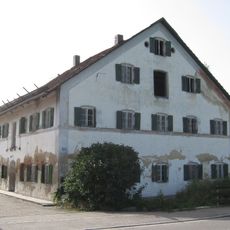
Kraftwerk Eitting, Hydroelectric power station in Eitting, Germany.
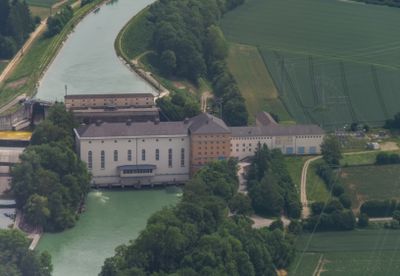
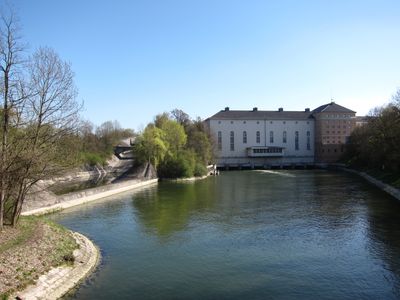
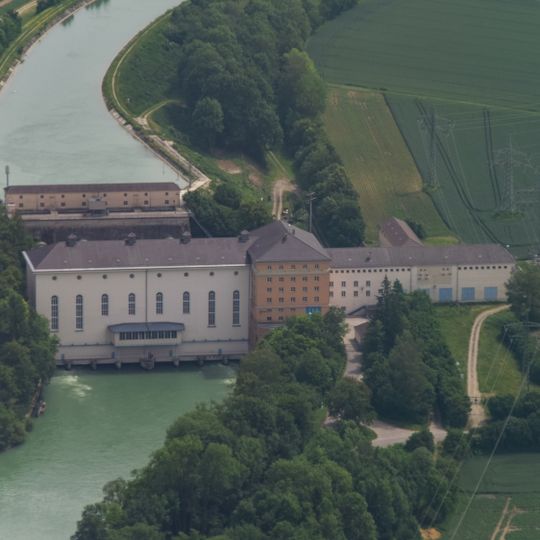
Kraftwerk Eitting is a run-of-river hydroelectric station on the Mittlere-Isar Canal, built 1921–1925 to a design by Munich architect Karl Söldner and protected as a Bavarian monument. Water drops 25.3 m through four 5 m pressure pipes about 30 m long to four Francis turbines in the machine hall set across the canal. The complex comprises a long light-grey building with a dark pitched roof and tall arched windows, a narrow brown brick block with a pyramidal roof, and a pale hall with blue doors.
Kraftwerk Eitting was built from 1921 to 1925 by Mittlere Isar AG as the fourth stage of the Mittlere-Isar Canal power station chain. The company passed to Bayernwerk, then E.ON, and the plant is now operated by Uniper Kraftwerke. A railway line from Altenerding to Pfrombach was built for the construction. The building, designed by Munich architect Karl Söldner, is a protected monument.
The power station reflects German industrial design from the 1920s and is protected as a historical monument in Bavaria. The buildings shape how the local landscape looks and tell the story of a time when people were finding new ways to produce energy.
The machine hall stands across the Mittlere-Isar Canal, with the discharge channel east of it; the complex is best viewed from the canal embankment and the surrounding paths. It is an operating power station, so the buildings are not open inside. The Altenerding–Pfrombach railway was built for its construction.
Eitting and the similar Aufkirchen plant were the first in the world to install Francis turbines lying horizontally with a vertical shaft, each driving a generator mounted above it on a heavy vault. Water reaches the four turbines through penstocks 5 m in diameter and about 30 m long, at a head of 25.3 m.
The community of curious travelers
AroundUs brings together thousands of curated places, local tips, and hidden gems, enriched daily by 94,226 contributors worldwide.