Hetzdorfer Viadukt, Railway viaduct in Flöha, Germany
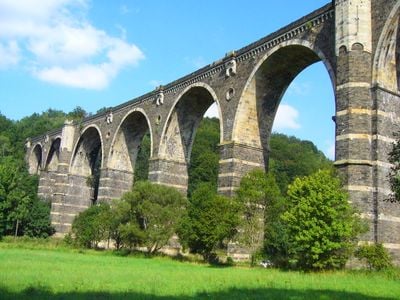
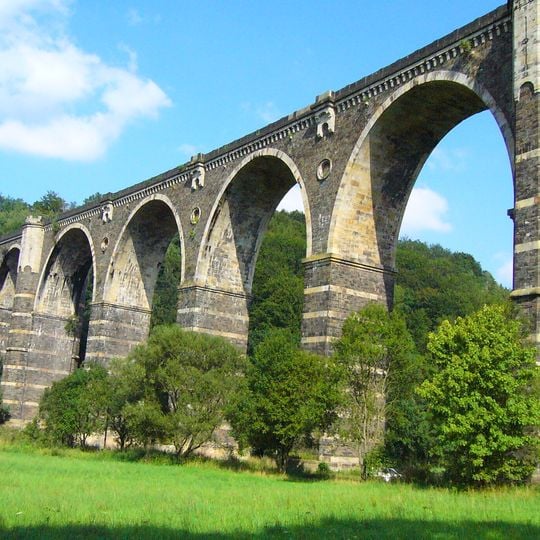
The Hetzdorfer Viadukt is a 328 m long, 43 m high former railway bridge over the Flöha valley, built of blue-grey gneiss, granite and Pirna sandstone. Its 17 arches vary in span: four central arches of 22.66 m, then two and five of 16.99 m, and three of 5.66 m at each end. The plan is straight for the first quarter and then curves with a radius of 572 m.
The viaduct was built between 1866 and 1868 as part of the railway line connecting Dresden and Chemnitz. After the railway line was closed in 1992, the structure lost its original function.
The viaduct is named after Hetzdorf, the village near Falkenau it crosses above the Flöha valley. Since the 1990s it has carried the long-distance Baltic Sea–Saaletalsperren hiking trail between Oederan and Augustusburg, and in autumn 1989 people tried to jump onto refugee trains from Prague to Hof because trains crossed it so slowly.
The structure today serves as a walking and cycling path that offers fine views of the valley. Visitors should note that the surface is uneven and sure footing is needed to cross safely.
The bridge's plan is not symmetrical: the first quarter runs straight before the alignment curves with a radius of 572 metres. In autumn 1989 people tried to jump onto refugee trains from Prague to Hof because trains crossed the viaduct slowly.
The community of curious travelers
AroundUs brings together thousands of curated places, local tips, and hidden gems, enriched daily by 94,016 contributors worldwide.