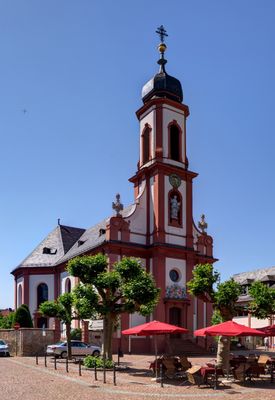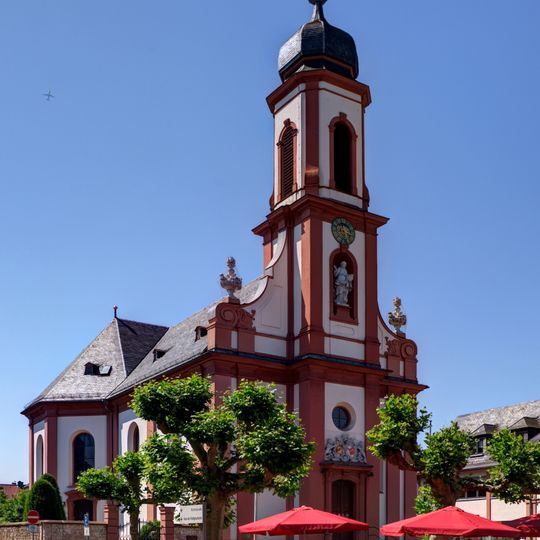
St. Cäcilia, Baroque church in Heusenstamm, Germany.
St. Cäcilia is a Baroque church built from 1739 to 1741 by Johann Balthasar Neumann for the Schönborn counts. Its cross-shaped plan has a central bell tower with a portal and an onion dome, a facade with curved gables and pilasters, and a grey slate roof. The pale pinkish-white walls have red corners and window frames; a statue stands in a tower niche.
Johann Balthasar Neumann designed this building as a burial chapel for the Schönborn family, constructing it between 1739 and 1741. The structure emerged during a period when this noble family sought to strengthen their power and influence in the region.
The church is dedicated to Saint Cecilia, patron saint of church music. Since 1756, the parish has celebrated its Kirchweih (kerb) on the Sunday before the Feast of the Apostle Matthew, a local fair commemorating the dedication.
The building is located in the town of Heusenstamm and can be reached on foot from the town center. Visitors should allow time to examine both the exterior architecture and the artwork inside.
Maria Theresia von Schönborn died in Vienna in 1751, the year the wooden furnishings were installed, and was buried there; her heart was removed and placed in the Schönborn crypt beneath the church. The crypt was then filled with other deceased members of the Heusenstamm line of the family.
The community of curious travelers
AroundUs brings together thousands of curated places, local tips, and hidden gems, enriched daily by 93,723 contributors worldwide.