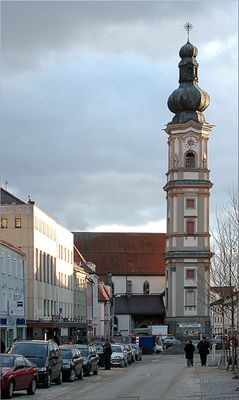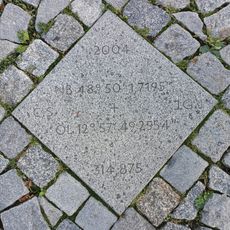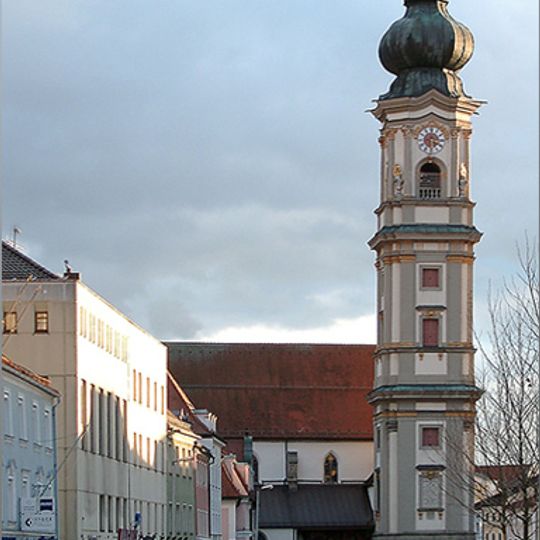
Grabkirche, Church building in Deggendorf, Germany.
The Grabkirche, formally Heilig-Grabkirche St. Peter und St. Paul, is a three-aisled basilica with a single-aisled choir at the southern end of Deggendorf's town square. Its 70-metre tower, built 1722–1727, is crowned by a replica of the Gnad monstrance. The tower has a white clock face, an open arched belfry and a green onion dome.
The church was built after the 1338 burning of Deggendorf's Jews, a pogrom linked to citizens' debts; it received the patronage of the Body of Christ and Saints Peter and Paul in 1361. Its 70-metre tower was begun in 1722 to plans by Johann Baptist Gunetzrhainer, continued by Johann Michael Fischer and consecrated at Easter 1728. The vault of the south aisle collapsed in 1994; restoration from 2004 ended with the altar consecration in April 2012.
The name Grabkirche refers to the Holy Grave, not a burial place: the church was built after the 1338 burning of Deggendorf's Jews and became the goal of the Deggendorfer Gnad pilgrimage, which the Regensburg bishop ended in 1992. Inside, the Bäckeraltar of around 1510 shows the Flight into Egypt, the Circumcision, the Entombment and the twelve-year-old Jesus in the Temple.
The church stands at the southern end of Deggendorf's town square, so it is reached on foot from the pedestrian centre. The 70-metre tower, crowned by a copy of the Gnad monstrance, is the landmark to aim for. The nave was re-Gothicised in the 19th century, and the vault of the south aisle collapsed in 1994, so expect restored interior surfaces.
In 1992, the Bishop of Regensburg officially severed this church's connection to a long-standing pilgrimage tradition, shifting its role within the community. This change marked a turning point in the building's history and its place in local religious life.
The community of curious travelers
AroundUs brings together thousands of curated places, local tips, and hidden gems, enriched daily by 94,548 contributors worldwide.