Schleusengraben, Heritage canal in Bergedorf, Germany.
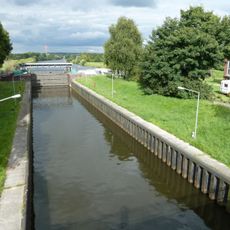
The Schleusengraben is a canal about 2.6 km long in Bergedorf, dug from 1443 partly along the sunken Löse arm of the Bille. It links the old Bergedorf harbour of Serrahn with the Dove Elbe, and the Bille's water was diverted into it to scour the channel. Since 1929 the Krapphofschleuse at its mouth has kept it off the tide.
The canal was dug from 1443, partly reusing the silted Löse arm of the Bille, after Lübeck and Hamburg had taken Bergedorf in 1420; the Bille's water was diverted through it to scour the bed, which dried up the middle Bille. Until the Krapphofschleuse opened at the Dove Elbe mouth in 1929 the canal was tidal. In the 19th century it carried Bergedorf's early industry, then lost ground to the railway.
The canal's name comes from the lock (Schleuse) that regulated its water. The harbour basin at the northern end, the Serrahn, was Bergedorf's port, used from the 15th century for timber and stone from the Sachsenwald forest. Today the canal carries only sport and tourist boats, and the Schleusengärten project plans around thirty berths for houseboats.
You can enter the canal area at several points and walk or cycle along the banks at a comfortable pace. The paths are open to the public and offer multiple ways to explore the waterway and surrounding landscape.
The canal partly follows the Löse, a silted branch of the Bille, and its water was diverted from the Bille so the current would scour the bed and keep it navigable without dredging. That diversion dried up the middle Bille. Until the Krapphofschleuse opened at the Dove Elbe mouth in 1929, the canal was tidal.
The community of curious travelers
AroundUs brings together thousands of curated places, local tips, and hidden gems, enriched daily by 93,815 contributors worldwide.