Stollen, Mining heritage site in Sommerkahl, Germany.
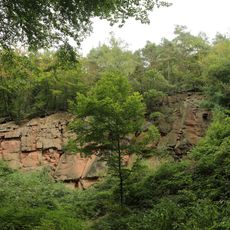
Grube Wilhelmine is a former copper mine at the eastern edge of Sommerkahl in the Bavarian Spessart. Its adit opens into galleries cut through Schöllkripp gneiss, where veins carry chalcopyrite, bornite and tennantite together with barite and quartz. Green malachite and blue azurite crust the rock, and the same discolourations show on the steep wall of the original open pit above the entrance adit.
First documented in 1542, the mine began with open-pit extraction of iron- and copper-bearing minerals. From 1870 the Frankfurt merchant Justus Matthäus Bastert expanded underground copper mining and had the ore processed at a nearby leaching works; his Justushütte smelted the copper at Damm. Between 1920 and 1922, over 100 miners raised about 70 tonnes of ore daily, yielding only about one tonne of smelter-ready material. Operations ceased in 1923 for lack of profitability.
The adit is named after the Wilhelmine copper mine, first documented in 1542 and worked until 1923. Visitors see green malachite and blue azurite crusting the rock in the galleries and on the open-cast wall above the entrance adit; these colourful copper carbonates served miners as prospecting minerals for locating ore at the surface.
The accessible section is located on a lower level and has been developed by a local association for visitor safety and comfort. Bring warm clothing since underground temperatures remain cool year-round, and wear sturdy footwear for uneven passages.
In winter the adits and shafts are closed except for entry and exit slits, serving as a roost for many bats, including the greater mouse-eared bat. For this reason the mine cannot be visited in the cold months; the nocturnal animals then seek warmer sleeping places nearby.
The community of curious travelers
AroundUs brings together thousands of curated places, local tips, and hidden gems, enriched daily by 94,262 contributors worldwide.