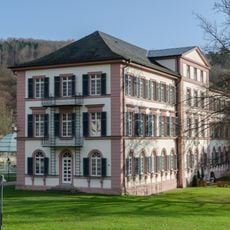
Sinntalhof, Historical smallholding in Bad Brückenau, Germany.
Sinntalhof is a rural estate near Bad Brückenau, in the southwestern part of the Bavarian Rhön mountains, made up of two main buildings known as the Old and New Sinntalhof. The property brings together residential and agricultural structures on a single plot set within the open countryside.
Moritz, the state fountain administrator at Bad Brückenau, built the Sinntalhof in 1821 as his retirement home. In 1893 Amelie Moritz brought the estate into her marriage to the sculptor Sebastian Putz. A cyclone damaged it in 1910, prompting the same-year construction of the New Sinntalhof as a guesthouse; the Old Sinntalhof was restored. Charlotte Putz handed the estate to the Bruderhof community in 1955, and it left their hands again in 1961 after legal disputes.
The name Sinntalhof comes from the Sinn valley, which takes its name from the stream running through the Rhön region. Visitors walking the grounds can see how the old farm buildings sit naturally within the rolling landscape around them.
The estate sits in the hilly landscape of the Rhön region and is easiest to reach by car or on foot from Bad Brückenau. Sturdy shoes are a good idea, as the paths around the grounds can be uneven.
The Bruderhof community held the estate only from 1955 to 1961, when legal disputes forced it to give up the buildings. In 1956, 25 members lived there in common ownership of goods, with ties to Britain, the United States and Paraguay. The sculptor Charlotte Putz, youngest sister of Ernst Putz, handed the property over in 1955 and belonged to the community herself.
The community of curious travelers
AroundUs brings together thousands of curated places, local tips, and hidden gems, enriched daily by 94,020 contributors worldwide.