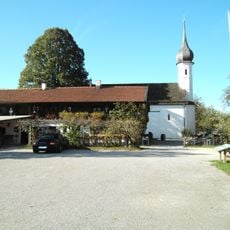
St.-Jakobus-Kirche, Romanesque church in Prien am Chiemsee, Germany
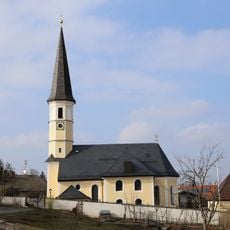
St.-Jakobus-Kirche is a Romanesque church building in Prien am Chiemsee with characteristic semi-circular arches, stone walls, and ornamental details throughout. The structure displays classical features of the period including columns, capitals, and carefully crafted architectural elements.
The church was part of a castle complex built between 1158 and 1200 by the Counts of Falkenstein, who had received the advocacy over Herrenchiemsee Abbey in 1158. The Falkensteins chose Saint James as patron, and only a defensive tower of the castle wall survives, later joined to the church through a breach. In 1711 the church received a new roof frame with a small onion-domed turret above the apse, and Baroque work covered the medieval paintings until they were uncovered in 1927 and 1941/42.
The church is dedicated to Saint James, patron saint of the Falkenstein counts, who built the castle complex here between 1158 and 1200. A carved Baroque figure of Saint James stands in the niche of the original entrance, now walled up, on the north wall. The unusual fresco of a 'living hanged man' refers to a miracle attributed to Saint James.
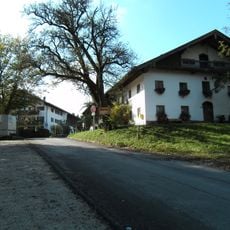
The church stands on a hill west of the Chiemsee plain in the Urschalling district; access is via the lane through the village. The interior floor was restored to its original level in 1966–1968, so the choir is reached by six steps. The walls are thick and the space is unheated; the frescoes are sensitive to humidity.
The Trinity fresco in the apse is often read as showing the Holy Spirit as a woman, though it is more likely a beardless youth. Nearby is a rare depiction of a "living hanged man", referring to a miracle attributed to Saint James. The 1390 Gothic painters repainted the older Romanesque motifs in their own style without changing them.
The community of curious travelers
AroundUs brings together thousands of curated places, local tips, and hidden gems, enriched daily by 94,084 contributors worldwide.