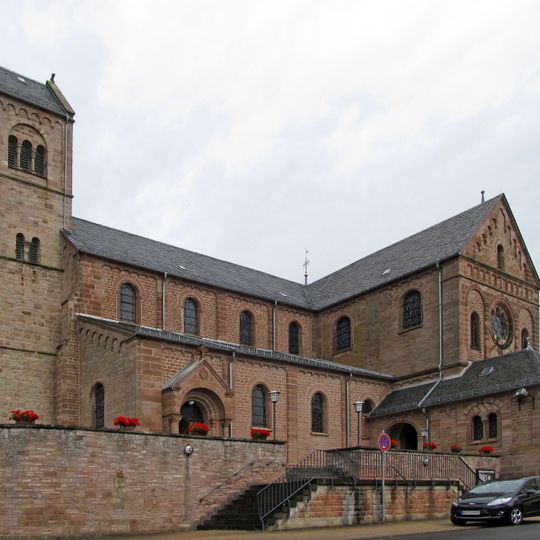
St. Remigius, Parish church and architectural heritage monument in Bliesen, Sankt Wendel, Germany
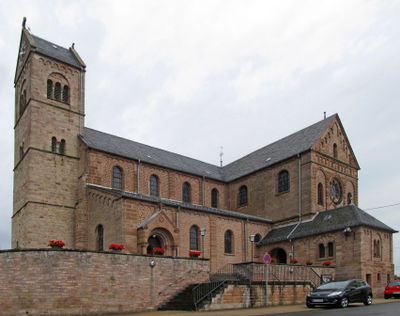
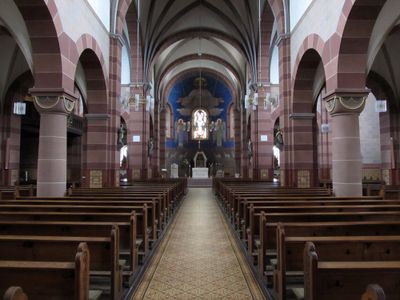
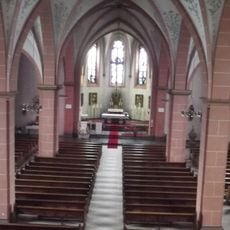
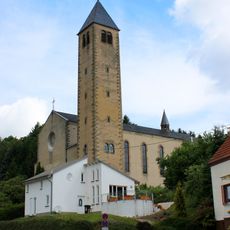
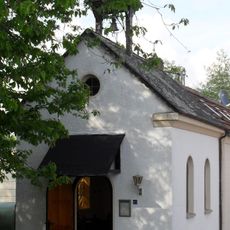
St. Remigius is a Romanesque Revival church built of rough red sandstone blocks, with a square west tower capped by a steep slate roof. The nave has a central vessel and lower side aisles, round-arched windows, and a projecting entry porch; inside, layered reddish and pink stone piers carry ribbed vaults.
A first church stood in Bliesen from 1220; a Gothic successor followed in the 15th century, and its tower received a Baroque portal in 1730 that survives. The third church was consecrated on 8 July 1751. Population growth made it too small, so the council decided on 18 August 1901 to build anew to plans by Düsseldorf architect Josef Kleesattel. The cornerstone was laid on 20 September 1903, and Bishop Michael Felix Korum consecrated the church on 6 July 1905.
The church remains a gathering place for Sunday services and religious celebrations that shape community life in Sankt Wendel. People here observe Catholic traditions passed down through generations, making it a living center of faith and local customs.
The church stands on raised ground above the upper Bliestal, reached by steps with a metal handrail from the lower paved area. The west tower holds the entrance portal, and the nave opens ahead through a three-aisled arcade toward the choir and apse. The tower was raised by about 10 m in 1904, giving a total height of 28 m to the stone cross.
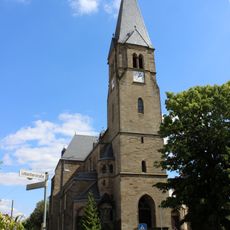
The tower is the oldest part of the church; a conservation report dates it to the 12th century, though a local tradition claims it once belonged to a Roman watchtower. In 1904 it was raised by about 10 metres with a saddleback roof, bringing its total height to 28 metres.
The community of curious travelers
AroundUs brings together thousands of curated places, local tips, and hidden gems, enriched daily by 92,943 contributors worldwide.