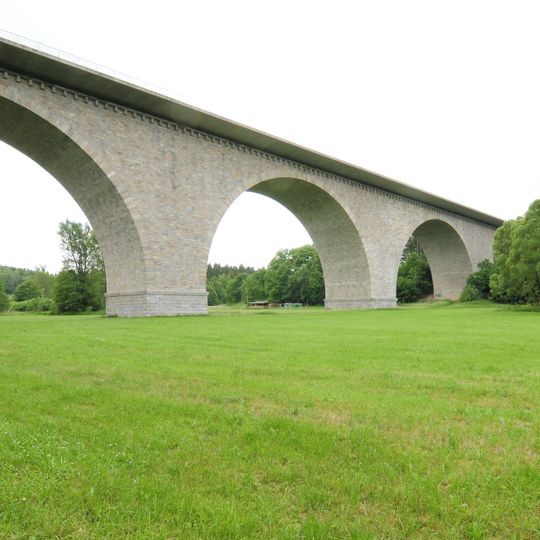
Göltzschtalbrücke, Stone arch bridge in Reichenbach im Vogtland, Germany
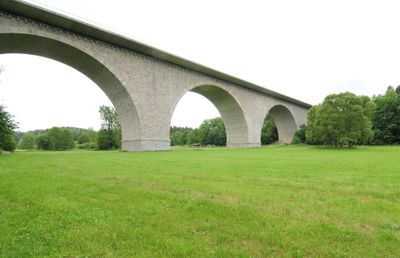
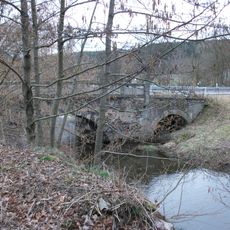
The Göltzschtalbrücke is a 364-metre-long road bridge on the A 72 motorway, crossing the Göltzsch valley near Weißensand. Its structure is a natural stone masonry arch design with five arches spanning 50.5 metres each, supported by piers 62 metres apart. The bridge reaches a maximum height of 35 metres and contains infill concrete in its interior.
The bridge was built between October 1937 and December 1938 as part of the Vogtlandautobahn, planned for four lanes but completed with only two because of wartime shortages of workers and material. Retreating German soldiers blew it up in April 1945; reconstruction under the Soviet occupation ended in October 1948. From 1992 to 1994 it was thoroughly renovated and widened to four lanes plus two hard shoulders.
The bridge at Weißensand gives its name to Auguste Lazar's 1965 book "Die Brücke von Weißensand", which recounts how villagers rescued two women from a passing prisoner transport from KZ Groß-Rosen in early March 1945. During the DDR era, pedestrians could still cross the bridge.
The bridge is easy to reach from the B173 road between Reichenbach and Plauen, with parking areas and viewing points nearby. Visitors get the best views from different angles in the valley below and from paths that run along the banks of the Göltzsch River.
The bridge's five arches have clear spans of 50.5 m and pier spacing of 62 m, with a maximum height of 35 m. During the GDR era, before the A 72 was widened, pedestrians could cross the bridge on foot. Author Auguste Lazar titled a 1965 narrative "Die Brücke von Weißensand" after it.
The community of curious travelers
AroundUs brings together thousands of curated places, local tips, and hidden gems, enriched daily by 93,995 contributors worldwide.