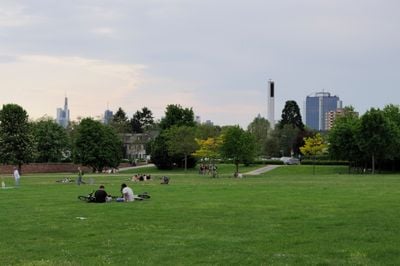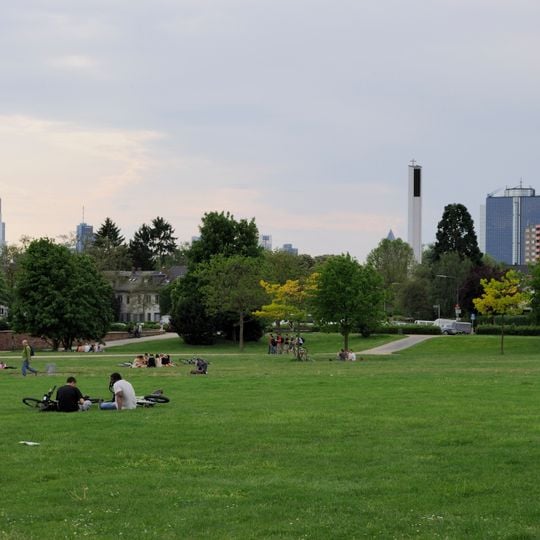
Günthersburgpark, Urban park in Nordend-Ost, Frankfurt, Germany
Günthersburgpark is a 7.4-hectare public park in Frankfurt's Nordend-Ost, laid out as an English landscape garden with large lawns and groups of trees. The northern part is open meadow, and a further 4-hectare meadow lies north of Weidenbornstraße. In the western section stands a larger-than-life bull of hammered copper sheeting, made in 1910 after a design by painter Fritz Boehle.
The site was first recorded in 1189 as Ossenau; in 1690 the innkeeper Johann Jacob Günther bought it and built the Günthersburg, a small moated castle with a drawbridge, which gave the park its name. Around 1800 the estate passed to the Rothschild family, and Carl Mayer von Rothschild had city gardener Sebastian Rinz lay out an English landscape garden with lawns and groves between 1837 and 1839. After 1855 the castle was demolished for Friedrich Rumpf's Villa Günthersburg summer palace. Mayer Carl von Rothschild, its last Frankfurt resident, died in 1886 without heirs and left the grounds to the city on condition that the palace be torn down and the park opened to the public; the city acquired it in 1891, Andreas Weber redesigned it, and it opened as a public park on 26 June 1892.
The park's name comes from the Günthersburg, a small moated castle with a drawbridge built in the late 17th century by the innkeeper Johann Jacob Günther, who had made his fortune supplying armies in the Thirty Years' War. The castle was demolished after 1855; only the 1855 orangery survives, rebuilt after wartime damage and used from 1950 as the Gnadenkirche chapel.
The park lies in Nordend-Ost, with its main historic entrance gate on Hartmann-Ibach-Straße, restored in 2010. The northern meadow beyond Weidenbornstraße adds about 4 hectares to the 7.4-hectare grounds. A large children's playground with a water basin dates from 1985, and the adventure playground and water play are in the park itself. The square on the west side toward Rohrbachstraße has been called Jina-Mahsa-Amini-Platz since 16 September 2024.
The 1855 orangery is the only building of the Rothschild estate still standing; the Villa Günthersburg summer palace was demolished after Mayer Carl von Rothschild's death in 1886, as his will required. Heavily damaged in World War II air raids, the orangery was restored and served from 1950 as the Gnadenkirche church.
The community of curious travelers
AroundUs brings together thousands of curated places, local tips, and hidden gems, enriched daily by 92,602 contributors worldwide.