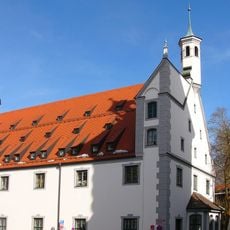
Rotes Tor, Historic city gate in Augsburg, Germany.
Rotes Tor is a city gate in southern Augsburg, first documented in 1223 and rebuilt in 1371 after a fire. It was raised and expanded in the 15th century and redesigned in 1604 by city architect Elias Holl. The gate, with its bridge, foregate, bastion and moat, forms the largely intact Rote-Torwall complex; its name comes from the red paint restored in the 20th century.
First documented in 1223, the gate may have existed on this site since 1187. It served as Augsburg's southern city gate on the Via Claudia route toward Tirol and Italy. After a fire, it was rebuilt in 1371, and in 1388 a moat and bridge were added. In 1777 the wooden bridge was replaced by a stone structure that also functioned as an aqueduct.
The gate's name comes from the red paint it bore in the Middle Ages, restored during 20th-century renovation work. Since 1929 the Augsburg open-air theatre has occupied the area south of the gate, which now forms its backstage zone and can only be driven through by authorised persons. The sundial on the tower's south side is legible only from the theatre and the ramparts.
The gate stands in the south of Augsburg's old town, within the Rote-Torwall complex of gate, bridge, bastion and moat. Since 1929 the open-air theatre occupies the area in front of it, so the gate itself lies in the theatre's closed backstage zone and can only be passed by authorised persons. The sundial on the south side is legible only from the theatre or the ramparts.
The gate once had a near-twin in Augsburg: the Gögginger Tor, rebuilt by Elias Holl, which was demolished in 1862. The Rotes Tor survived because the city decided in the mid-19th century not to dismantle it when the fortifications were decommissioned.
The community of curious travelers
AroundUs brings together thousands of curated places, local tips, and hidden gems, enriched daily by 92,639 contributors worldwide.