Gut Schwaighof, Architectural heritage monument and park in Allmannshofen, Germany.
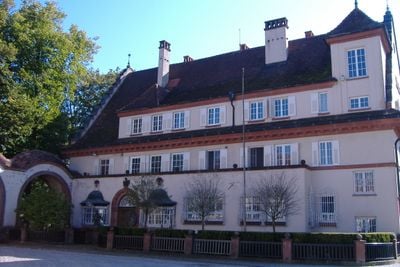
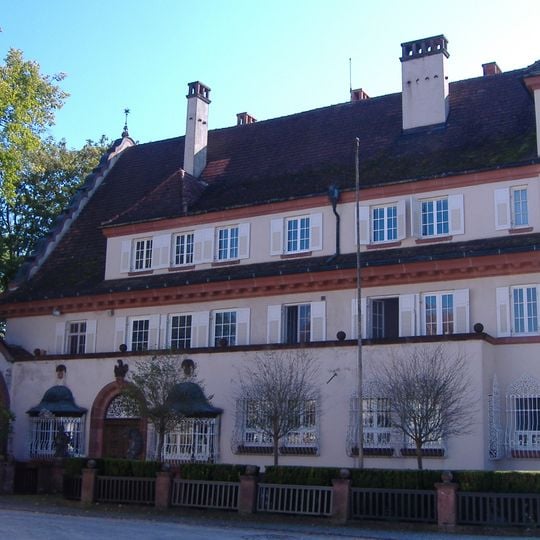
Gut Schwaighof is a two-storey estate building near Allmannshofen, north of Augsburg, between the Schmutter river and the road from Nordendorf to Donauwörth. Its pale pinkish-beige facade is divided by a band of reddish stone; the steep dark red tiled roof carries two tall chimneys with pale caps. The upper windows have white frames and grey shutters, and a central arched doorway with a carved surround is flanked by two small semicircular canopies.
Gut Schwaighof began as a Schwaighof of Holzen Abbey. With secularisation it passed to the Counts of Fischler-Treuberg around 1800, and in 1918 the indebted estate was sold to the Kaiserslautern casting and fittings works, whose director Carl Billand acquired part as a private residence. His descendants, the Zeising family, still own it.
The name Schwaighof refers to a type of farmstead held by a monastery; this one belonged to Kloster Holzen until secularisation around 1800. Today the estate is a Trakehner stud farm, with the Zeising family breeding horses here since the early 1960s, alongside a dairy, arable and market-gardening operation.
The estate lies between the road from Nordendorf via Druisheim to Donauwörth and the Schmutter stream, north of Augsburg. The park is not open for free roaming: it can be visited only on guided tours, held regularly on the Day of Open Monuments.
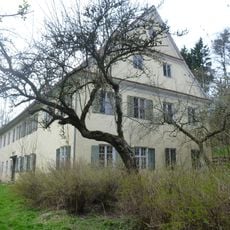
One estate building, immediately right of the drive, was built around an existing tree: the trunk stands inside the structure and only the crown shows outside. The park also holds a bronze "Flötenbläser" bought from Gustav Allinger's exhibition garden at the 1926 Dresden horticultural show.
The community of curious travelers
AroundUs brings together thousands of curated places, local tips, and hidden gems, enriched daily by 94,371 contributors worldwide.