Église de l'Assomption de Memmingen, Modern parish church in Memmingen, Germany.
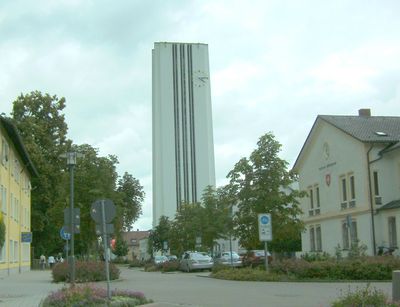
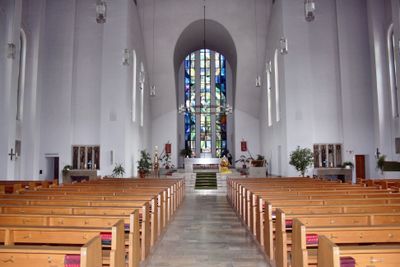
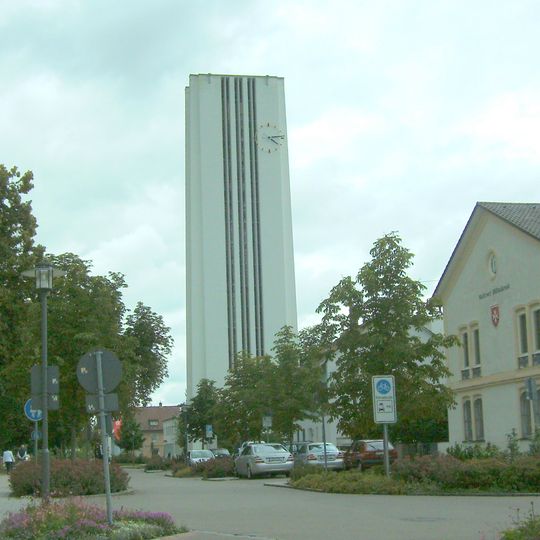
Mariä Himmelfahrt is a Catholic parish church on Augsburger Straße in eastern Memmingen, built 1954–1956 to Thomas Wechs's design. Its square interior is spanned east to west by two reinforced-concrete arches with a maximum span of 42.50 m and a crown height of 18 m. A 48.50 m tower, 58.50 m with its inverted Peter's cross, stands before the entrance; its ground floor holds a Pietà by Andreas Bindl inscribed "Quo vadis?".
After the Second World War, more than 7,000 war refugees and 1,000 Baltic emigrants settled in Memmingen, most of them in the east of the city, which made a new Catholic church necessary. The first sod was turned on 11 October 1954, and Bishop Josef Freundorfer of Augsburg laid the foundation stone on 30 April 1955. He consecrated the completed church on 18 November 1956. The architect was Thomas Wechs, from Bad Oberdorf in the Allgäu, who developed a new sector church for the site.
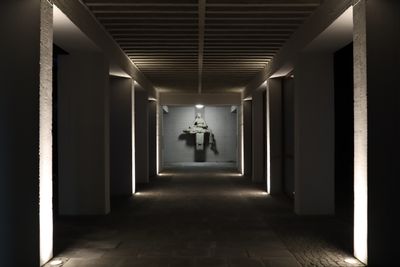
The tower cross is an inverted Latin cross, a Petruskreuz: Peter was crucified head-down so as not to profane Christ's upright death. In the tower's ground floor stands a Pietà by Munich sculptor Andreas Bindl, inscribed on its console with the Latin words "Quo vadis?". The copper doors were made by Augsburg artist Georg Bernhard.
The church stands on Augsburger Straße in the east of Memmingen, not in the town centre. The tower base holds the war memorial with the Pietà, so the entrance area is reached at street level; the interior is entered from the side facing the road.
The tower cross is an inverted Latin cross, a Petruskreuz: Peter was crucified head-down so as not to profane Christ's upright death. At the tower's base, a Pietà by Munich sculptor Andreas Bindl carries the Latin inscription "Quo vadis?" on its console.
The community of curious travelers
AroundUs brings together thousands of curated places, local tips, and hidden gems, enriched daily by 94,555 contributors worldwide.