Segeberger Kalkberg, gypsum hill in Bad Segeberg, Germany
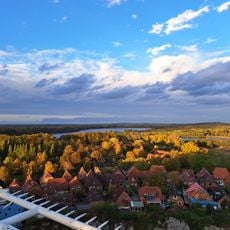
Segeberger Kalkberg is a 91-metre rock in the centre of Bad Segeberg made of gypsum near the surface and anhydrite in its unweathered core, not limestone. Paved paths lead to a summit platform with views across the Schleswig-Holstein hills, and a staircase descends to the rim of a 43-metre-deep well shaft from the former Siegburg Castle.
Emperor Lothair founded Siegburg Castle on the hill, then called Alberg, in 1134. It was the residence of the County of Holstein-Segeberg, where Adolphus VII was murdered in his bed in 1315. Swedish troops destroyed the castle during the Thirty Years' War, and gypsum quarrying from the summit then reduced the hill to 91 metres; only the lower half of the well shaft survives.
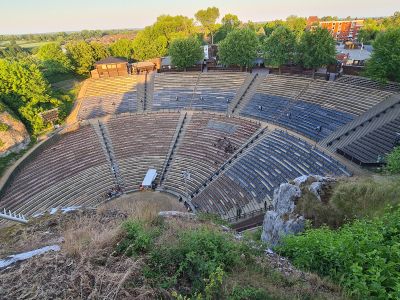
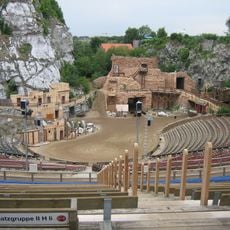
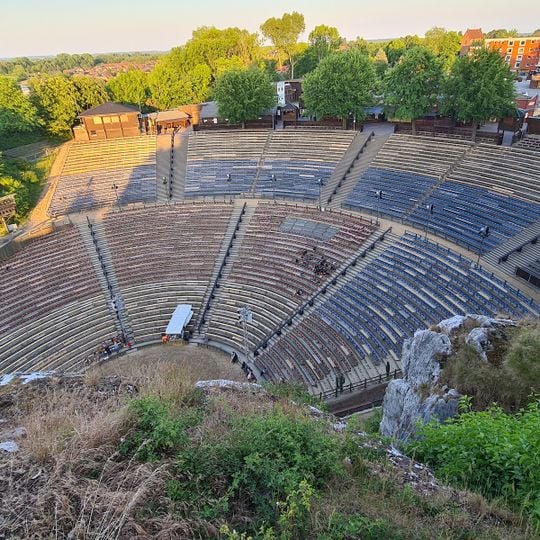
Since 1952 the Karl May Festival has been staged every year in the Kalkberg Stadium, an open-air theatre of about 7,800 seats and room for 12,000 standing, built from 1934 into the pit left by gypsum quarrying. It opened in 1937 as a "Nordmarkfeierstätte" attended by Joseph Goebbels.
The summit is reachable on foot, though the climb requires some effort along the sloping terrain. Those with mobility challenges should know that the steep ground and paths are not wheelchair accessible.
The hill is a misnomer: it is made of gypsum, not limestone, and its core is unweathered anhydrite. The salt dome below once fed the brine baths that gave Bad Segeberg its name, after drilling for salt in the 1860s failed and the boreholes flooded.
The community of curious travelers
AroundUs brings together thousands of curated places, local tips, and hidden gems, enriched daily by 92,783 contributors worldwide.