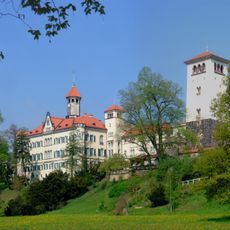
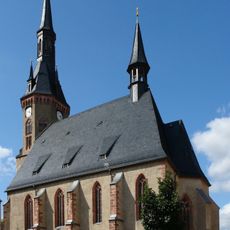
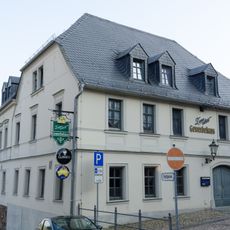
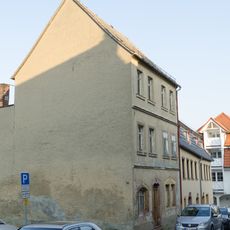
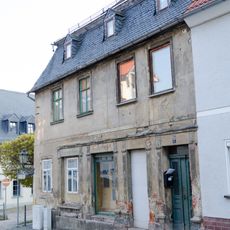
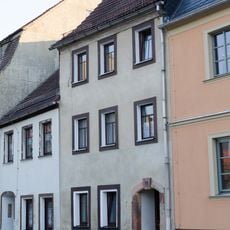
Naturalienkabinett Waldenburg, Natural history museum in Waldenburg, Germany.
Naturalienkabinett Waldenburg is a natural history museum in Waldenburg, Saxony, housed on the upper floor of a mid-19th-century building that was part of a princely residence. The collection is arranged in six original historic display cabinets and covers minerals, taxidermied animals, and decorative crafts.
The collection traces back to the Linck family, a Leipzig apothecary family who began gathering natural objects and curiosities around 1670, with the holdings eventually moving to Waldenburg. The building that houses it today was completed in 1846 as part of a larger princely residence.
The museum keeps the princely natural-history cabinet in its original 19th-century display-storage form, largely unchanged and protected as a monument. The name refers to the Schönburg-Waldenburg princes' cabinet, begun in 1840. Among the pieces is the 1735 specimen published as the "Hühnermensch von Taucha", a human fetus with extensive malformations.
The ground floor was made barrier-free during the renovation after the 2019 water damage, and the reception area was redesigned. The historic natural history cabinet on the upper floor was closed from 2025 for protection during construction work. The museum reopened in May 2026 under director Simon Bucher.
Among the roughly 116,000 objects is a preserved human fetus with extensive malformations, published in 1735 as the "Hühnermensch von Taucha" (chicken-human of Taucha). The museum also holds a mechanical world system by W. J. Blaeu from 1650 and coloured glass made by Johannes Kunckel around 1690.
The community of curious travelers
AroundUs brings together thousands of curated places, local tips, and hidden gems, enriched daily by 92,655 contributors worldwide.