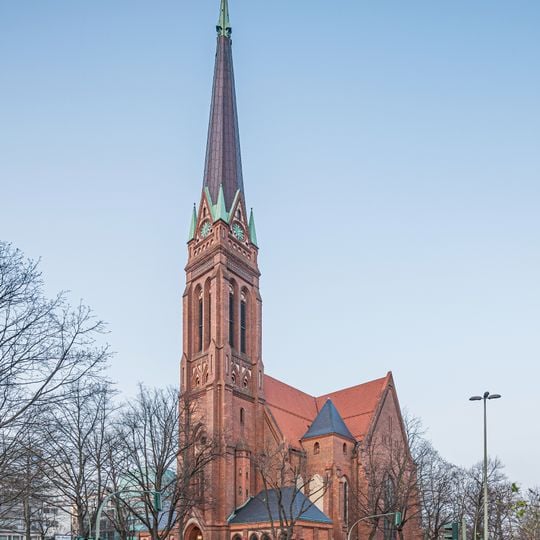
Church of the Savior, Neo-Gothic church in Moabit, Berlin, Germany
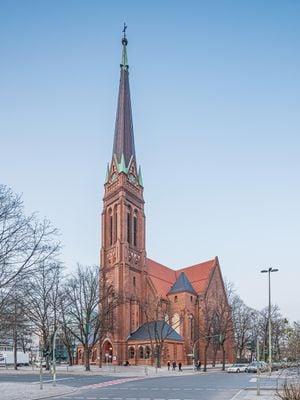
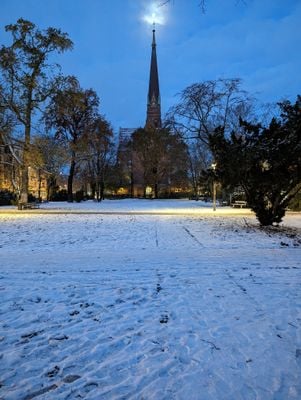
The Heilandskirche is a red-brick church on Thusnelda-Allee in Moabit, built 1892–1894 to a design by Friedrich Schulze and executed by Paul Kieschke. Its cruciform hall plan has short transepts, so it reads as a centralised building. The slender tower rises 87 metres to a steep copper-coloured spire with four small green pinnacles at its base; a polygonal turret and a lower dark-roofed section sit alongside.
Built 1892–1894 as a chapel of ease for the overcrowded St. Johanniskirche, on land cut from the Kleiner Tiergarten. Friedrich Schulze designed it and Paul Kieschke carried out the work; it was consecrated on 20 June 1894 and became an independent parish in 1896. A British air raid in November 1943 burned the roof and spire; Erich Ruhtz and Erich Glaß rebuilt it in simplified form, rededicated in 1960.
The church has served as a center for Protestant worship and community life since its establishment. Today it remains an active place for regular services that shape the spiritual rhythm of the neighborhood.
The church is easily accessible by public transportation, with several bus routes and a U-Bahn station nearby. Visitors should check opening hours and service times before planning their visit to the building.
The three cast-steel bells, made by the Bochumer Verein in 1893 and donated by Carl Bolle's family, survived both world wars because the authorities had no interest in steel castings. They still hang in a nearly square belfry measuring 4.4 by 4.5 metres, and their production cost 6,344 marks.
The community of curious travelers
AroundUs brings together thousands of curated places, local tips, and hidden gems, enriched daily by 94,060 contributors worldwide.