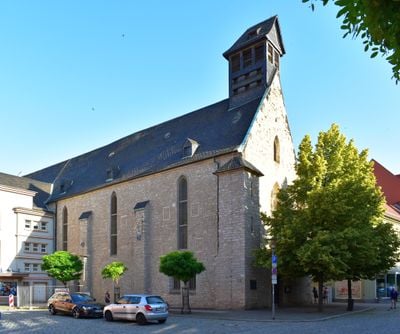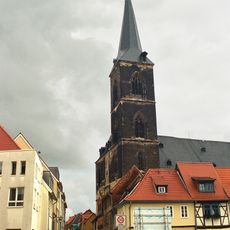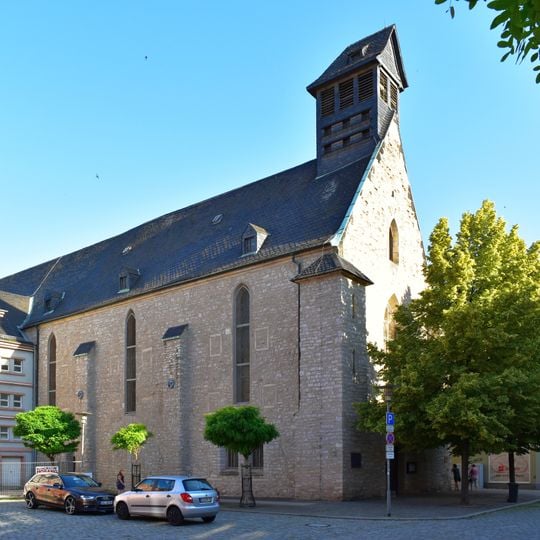
Heilig-Kreuz-Kirche, Gothic church at Market Square, Aschersleben, Germany
Heilig-Kreuz-Kirche is a single-nave church on Aschersleben's market square, built of rough grey stone with early Gothic forms. Its five equal bays are covered by cross vaults resting on plain wall pillars that begin two metres up; an organ gallery and a 1954 partition wall now leave only three bays visible. The long side wall has tall pointed-arch windows and two short buttresses capped with small roofs, and a square wooden tower clad in dark boards rises above the far end of the steep slate roof.
The founding year of the Franciscan monastery church is unknown; its forms point to the mid-13th century, and the monastery's oldest document dates from 1311. In 1525 the friars fled during the Peasants' War and never returned. In 1644 the church was converted into a horse stable, and in 1698 it was restored for the Reformed congregation.
The church is also called Marktkirche because it stands directly on Aschersleben's market square. Its five bays are covered by cross vaults whose plain keystones were painted around 1700 with the Elector's hat, a rose, the Brandenburg eagle and the town's coat of arms. Remains of older ceiling paintings survive under the plaster of the vault corners.
The church stands directly on Aschersleben's market square, so it is reached on foot from the surrounding old town streets. A dividing wall built in 1954 and the organ gallery mean only three of the five bays are visible inside. Look for the memorial to Lieutenant Colonel Louis de Feyrac on the east wall.
The church served as a garrison church for a cuirassier regiment; officers and their families were buried inside. In 1975, renovation work turned up the gravestone of Antoinette Wilhelmine Countess von Borcke, who died in November 1745 at two months old, reused upside down as a floor slab.
The community of curious travelers
AroundUs brings together thousands of curated places, local tips, and hidden gems, enriched daily by 93,997 contributors worldwide.