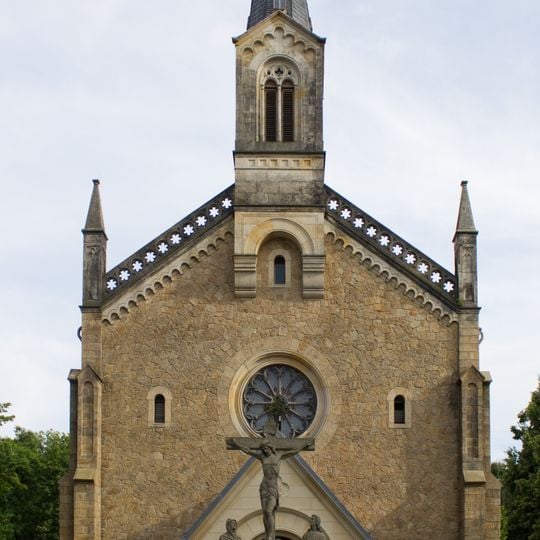
Heilig-Kreuz-Kirche, Catholic parish church in Görlitz, Germany.
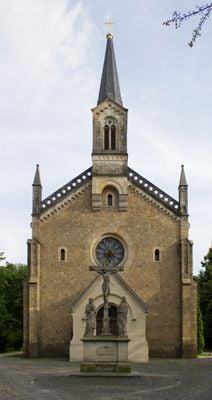
The Heilig-Kreuz-Kirche is a Romanesque Revival parish church built of rough Königshainer granite from the Limasberg, the same stone used for the nearby Neisse Viaduct. Its tan and grey facade centres on a rose window with dark tracery, flanked by two pointed pinnacles topped with crosses, and a square tower with paired arched windows and a pointed spire. The interior is a hall church with three naves; the high altar is of Silesian sandstone.
The foundation stone was laid on 27 August 1850 on a plot at Obere Kahle (today Struvestraße) at the corner of Friedrich-Wilhelm-Straße, and the church was consecrated on 27 April 1853. It was built to designs by August Soller, a pupil of Schinkel, after Catholics from Silesia had settled in the city from 1835. The date fell exactly 328 years after the three archpriests of Görlitz, Reichenbach/O.L. and Seidenberg decided to introduce the Reformation.
The church houses a chapel with a replica of the Black Madonna of Czestochowa, donated by members of the Polish Catholic community. This image reflects the close ties between the parish and Polish residents in the area.
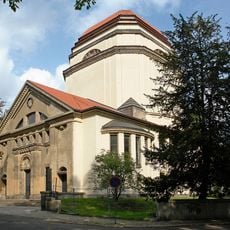
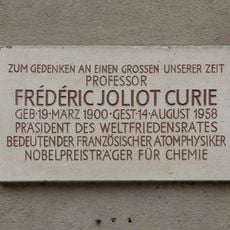
The church stands at the corner of Struvestraße and Joliot-Curie-Straße, next to the city park and the synagogue. The crucifix group on the forecourt was restored in 1994, and its foundations were repaired between 1999 and 2010 with Altstadtmillion funds. The interior was reworked in 2018, when the side altars were rebuilt in modern form.
The church is not oriented east as usual: its tower stands on the north side and the choir on the south. The walls are built of rough rubble stone from Königshainer granite at the Limasberg, the same granite used for the nearby Neisse Viaduct. The church measures 37 meters from ground to spire tip.
The community of curious travelers
AroundUs brings together thousands of curated places, local tips, and hidden gems, enriched daily by 94,632 contributors worldwide.