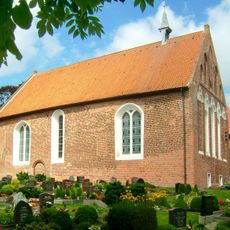
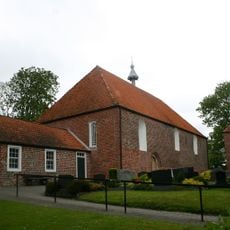
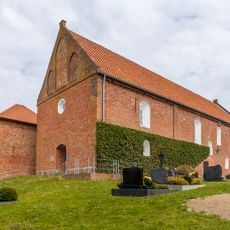
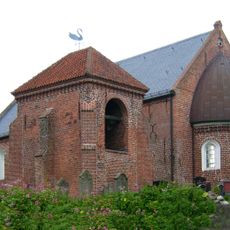
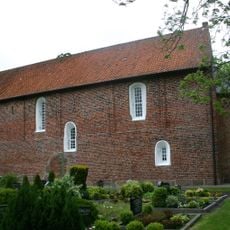
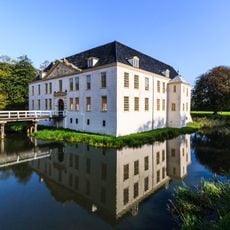
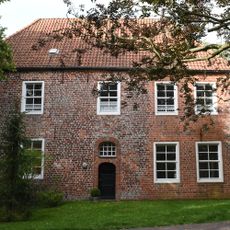
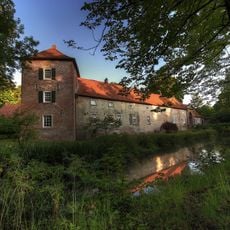
Organo della chiesa di San Bartolomeo, Pipe organ in St. Bartholomew Church, Dornum, Germany
The organ of St. Bartholomew Church was built in 1710–1711 by Gerhard von Holy and has 32 stops on three manuals and pedal. Its carved case stands on the west gallery; because the barrel vault is low, the 16′ Principal of the pedal begins only at B in the facade, with the deeper pipes behind as a Subbass. Five original wedge bellows survive.
An older organ, said to come from the dissolved Oldekloster monastery, was taken over around 1530. Gerhard von Holy built the present instrument in 1710–1711, reusing six stops of that predecessor. While work was under way he was also commissioned to add an independent pedal, placed on the west gallery because the south wall lacked room; the low vault forced the 16′ Principal to start at B, with the lower pipes behind as a Subbass. Hinrich Just Müller repaired it in 1764, Johann Diepenbrock rebuilt it in 1882–1883, and Jürgen Ahrend restored it in 1997–1998.
The instrument reflects northern German organ-building traditions with mechanical actions and wooden casings built directly above the entrance. Visitors can observe the craftsmanship and hear how these design choices shape the sound during performances.
The church is typically open during daytime hours, and concerts are held regularly throughout the year. It is best to check ahead for the current schedule to find when musical performances are taking place during your visit.
Six of the organ's registers still come from the late-Gothic predecessor instrument, and fourteen pipes date from Gerhard von Holy's 1710–1711 build. The five wedge bellows are also original, and the 1997/1998 restoration by Jürgen Ahrend recreated twelve later-replaced registers and the "extended" meantone temperament.
The community of curious travelers
AroundUs brings together thousands of curated places, local tips, and hidden gems, enriched daily by 93,594 contributors worldwide.