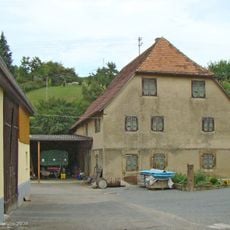
Hipfelhof, Historical estate in Heilbronn, Germany.
The Hipfelhof is a historic farm estate west of Frankenbach, part of Heilbronn. Its buildings cluster around a courtyard: the three-storey Cotta Villa (No. 6) from 1855, the former parish house (No. 10) built in 1791 and renewed in 1855, and the mill (No. 8) from 1784 with a two-storey granary annex. A chapel stood north of the estate until it was destroyed in the Second World War.
First documented in 1229, when Pope Gregory IX confirmed the Bebenhausen monastery's holdings at Hüppelbure. In 1250 Reichsvogt Wilhelm von Wimpfen gave his property to the Hospitaller master at Wimpfen. Around 1550 Heilbronn lent the Stephansfeld convent up to 17,700 gulden and held the Hipfelhof as pledge; in 1601 a convent master sold it to the city. In 1812 the von Cotta family acquired it and kept it until 1959.
The name Hipfelbeuren points to a former village settlement, of which only the estate remains; documents show that ownership was already fragmented in the 13th century. A pilgrimage chapel stood here in the Middle Ages, with a priest first recorded in 1475. The chapel north of today's farm was destroyed in the Second World War.
The Hipfelhof lies west of Frankenbach, in the north-west of Heilbronn. The buildings stand close together: the three-storey Cotta Villa (No. 6) in the north-west, the former parish house (No. 10) and the mill (No. 8) in the north-east. The site is a working farm estate, so visitors should stay on the paths and keep a distance from the buildings.
The Cotta'sche Villa in the northwest of the estate was built in 1855 and enlarged in 1865 and 1875; it stands in a park-like area. The estate also keeps a mill of 1784 with a two-storey granary annex, and a former parsonage of 1791, renewed in 1855.
The community of curious travelers
AroundUs brings together thousands of curated places, local tips, and hidden gems, enriched daily by 94,631 contributors worldwide.