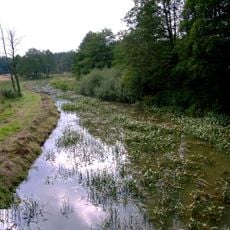
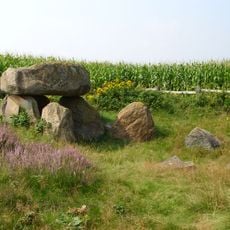
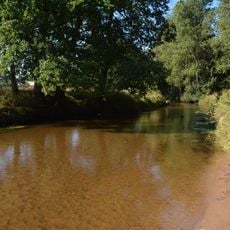
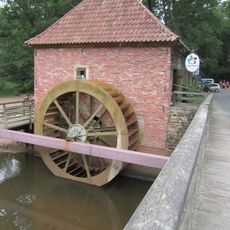
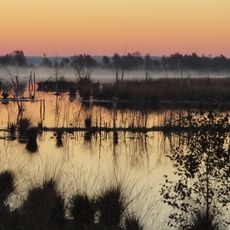
Huvenhoopsmoor, Protected moor ecosystem in Gnarrenburg, Germany.
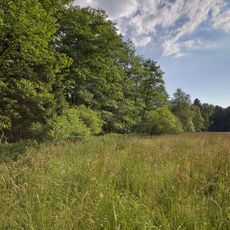
Huvenhoopsmoor is a moorland in North Lower Saxony with a 1.5-square-kilometre intact raised-bog remnant, mostly open ground with very few trees and a shrub border. The core, containing the Huvenhoopssee lake, may not be entered but is visible from an observation stand on the Moor-Erlebnispfad. A watertight sheet pile wall separates the remnant from drained surrounding areas.
Peat cutting around Gnarrenburg has continued for centuries, first by moor colonists and later on an industrial scale in the 19th century, when high-moor peat became popular as fuel in Bremen. Part of the Huvenhoopsmoor escaped drainage and extraction entirely; in the 1960s the intact remnants were sealed off with a watertight sheet pile wall. In 2006 the moor was added to the list of 77 National Geotopes.
The educational trail features a character called Huvi, the Moorkobold, who introduces visitors to the natural features at different stations along the path. This playful approach helps guests understand how the moorland functions.
The ground can become wet and slippery, especially after rain, so sturdy footwear and caution are recommended. Cyclists must walk their bikes along the marked paths, and visitors can explore safely by staying on the designated walkways.
The intact 1.5-square-kilometre core has never been drained or cut for peat and may not be entered; it is viewed from a observation stand on the Moor-Erlebnispfad. At its centre lies the Huvenhoopssee, one of Lower Saxony's last intact raised-bog lakes, where ducks can be watched through binoculars. In spring and October, thousands of cranes rest here for days on their way to and from breeding grounds in Eastern Europe.
The community of curious travelers
AroundUs brings together thousands of curated places, local tips, and hidden gems, enriched daily by 93,942 contributors worldwide.