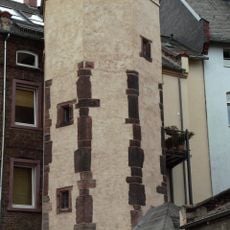
Höchster Schloss, Medieval château in Höchst district, Frankfurt, Germany
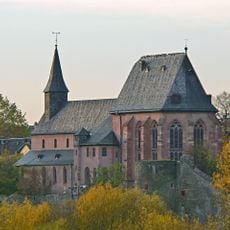
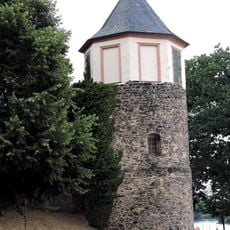
Höchster Schloss consists of the Altes Schloß, built between the 14th and 16th centuries, and the Neues Schloß from the late 16th century. The white main building has a rectangular plan, a round turret with a bell-shaped Renaissance hood at its northeast corner, and the Gothic bergfried with a baroque cupola at its southwest corner. The east gatehouse shows a Doric ground floor and an Ionic upper floor, with a Saint Martin relief in the frieze.
The so-called Old Castle replaced a 14th-century Gothic toll castle; only its keep survives, capped with a Baroque hood in 1681. After the Peace of Zeilsheim in October 1463, the deposed Archbishop Diether von Isenburg took up residence here. The remaining wing was rebuilt in 1586 in Renaissance style, but in January 1635 troops of Bernhard von Sachsen-Weimar burned the palace; its stones were reused in 1772 for the Bolongaropalast.
Since 1957 the Höchster Schloßfest has been held here each year in early summer, with the castle courtyard and terrace as its centre. The storm bell of the town, cast in 1475, once hung in the lantern of the keep's baroque dome; it now stands in a barred niche of the castle wall. Regular jazz events take place in the vaulted cellar.
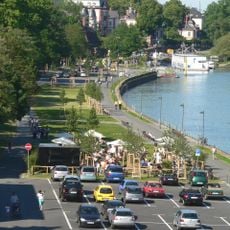
The castle courtyard, the redesigned terrace and the park in the former moat are open to visitors during the day, even while renovation work continues. The former Museum of Höchst History is closed for rebuilding and only partly accessible. Jazz events are held regularly in the castle cellar.
The storm bell of the city, cast in 1475, once hung in the lantern of the keep's baroque dome. It now rests in a barred niche of the castle wall, where visitors can spot it. A legend holds that a Brunswick captain named Zuckschwerdt refused to blow up the castle in 1635.
The community of curious travelers
AroundUs brings together thousands of curated places, local tips, and hidden gems, enriched daily by 93,811 contributors worldwide.