St. Katharina, Parish church in Garching bei München, Germany
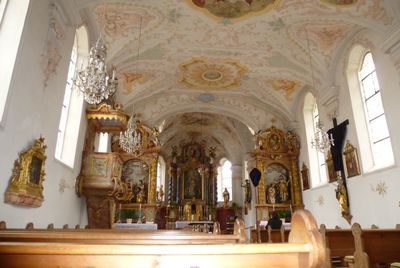
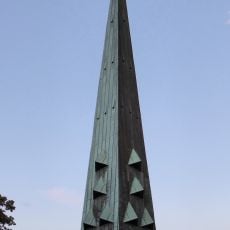
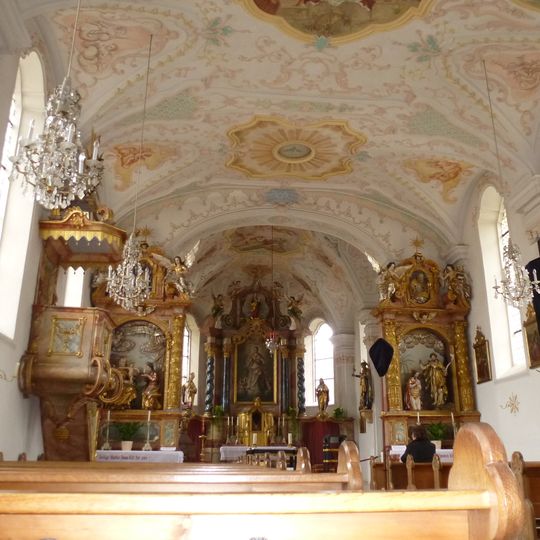
St. Katharina is the former parish church of Garching bei München, first documented as a parish church in 1260. The oldest surviving part is the Romanesque tower base from the 13th century; the nave, choir and sacristy were rebuilt in their present form in the late 15th century. Inside, a barrel vault with pale scrollwork and two oval medallions covers the nave, with a raised wooden pulpit with gold trim on the left wall and a side altar with a painted panel on the right.
A church in Garching was first mentioned around 760 and belonged to Tegernsee Abbey; around 1020 Bishop Egilbert of Freising gave the parish to Weihenstephan Abbey, which held it until the secularisation of 1803. The oldest surviving fabric, the Romanesque tower base, dates from the 13th century; nave, choir and sacristy were rebuilt in their present form in the late 15th century. Abbot Ildefons Huber had the interior baroquised in 1735/36, and on 17 September 1967 the consecration of St. Severin reduced St. Katharina to a subsidiary church.
The parish is documented from 1260, when the church was recorded as St. Maria Magdalena; the patronage of St. Katharina of Alexandria, whose feast day is 25 November, first appears in a 1524 parish description. Since the consecration of St. Severin on 17 September 1967, St. Katharina has served as a subsidiary church, and the adjoining churchyard was enlarged to the southeast in 1955.
St. Katharina stands in Garching's old village centre on Münchener Straße, close to the U-Bahn station Garching. A church cemetery surrounds it; this was enlarged to the southeast in 1955, and a municipal cemetery has existed on Freisinger Landstraße since 1963. The church is a side church since 1967, so check locally for opening times.
The stair to the tower's first upper floor is built inside the thickness of the 13th-century Romanesque masonry. A late Gothic fresco was uncovered above the portal only in 1950, during restoration; most of the painted Passion cycle on the side walls was lost when the windows were rounded in the Baroque period, and fragments survive in the attic.
The community of curious travelers
AroundUs brings together thousands of curated places, local tips, and hidden gems, enriched daily by 94,960 contributors worldwide.