Steinerne Brücke, Stone bridge in Weilburg, Germany
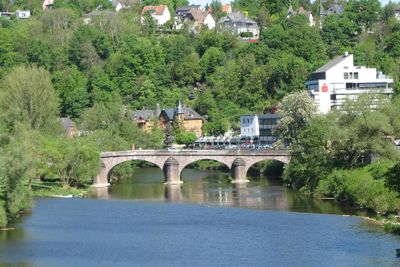
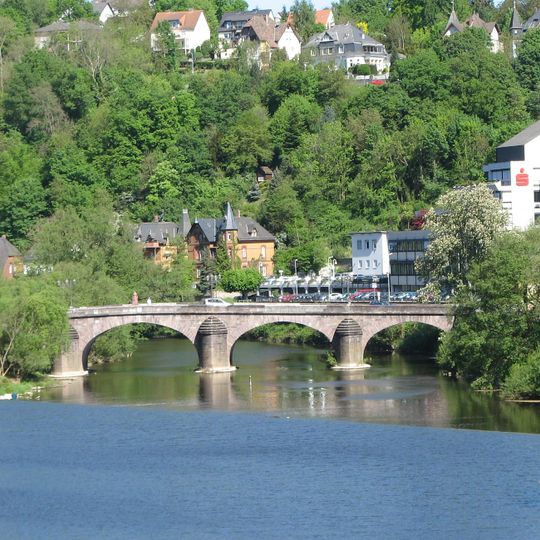
The Steinerne Brücke is a stone arch bridge over the Lahn in Weilburg, built from 1765 and clad in Lahn marble. Its five basket-handle arches have clear spans of 12.50, 14.10, 15.70, 14.10 and 12.50 metres, giving a total length of 83 metres. The fourth pier stands on an island, and the fifth arch crosses the Mühlgraben.
A wooden bridge stood here in the 14th century; Count Johann I of Nassau-Weilburg replaced it with a stone bridge in 1359. Floods with ice destroyed that crossing in 1408 and again in 1555, after which Count Philipp III built a third stone bridge. The fourth bridge, designed by building inspector Johann Friedrich Sckell for Prince Karl Christian, opened to traffic in 1765; it was paved in 1770 and given its parapet walls in 1774. German troops blew up two arches on 27 March 1945, and the bridge was repaired by 12 November 1946.
The bridge's name simply means "stone bridge", distinguishing it from the wooden predecessors on the same spot. Its cladding of Lahn marble, a local limestone, is visible on the parapets and pier heads. Catholic workers from the Westerwald built it; at their request, Catholic services were held in Weilburg again after about 200 years and continued after the work ended.
The crossing is open to pedestrians and offers views of the river landscape from above. Walking at a leisurely pace allows you to examine the stonework details and architecture thoroughly.
The bridge rests on pile grids of 600 beech and oak trunks driven into the riverbed for its foundations. Many Catholic workers from the Westerwald took part in the building; at their request, Catholic services were held in Weilburg again after about 200 years and continued after the work ended.
The community of curious travelers
AroundUs brings together thousands of curated places, local tips, and hidden gems, enriched daily by 93,839 contributors worldwide.