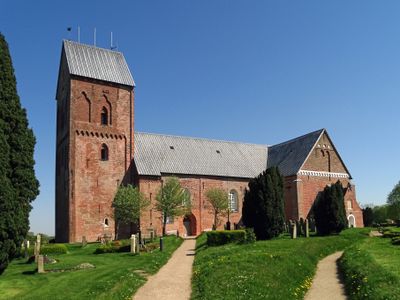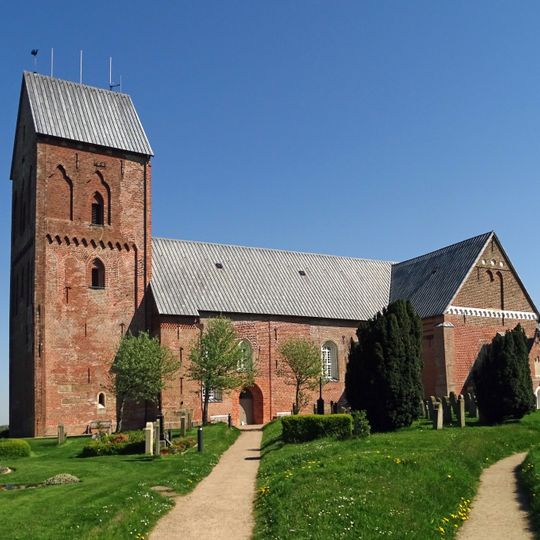
St. Johannis, Lutheran church in Nieblum, Germany.
St. Johannis is a brick church in Nieblum with thick walls and characteristic tile-roof architecture that defines the north German building style. The structure rises with its tall tower above the flat landscape of the island and houses a spacious interior with high ceilings.
St. Johannis was built in the first half of the 13th century, probably on the site of an earlier church, and is first mentioned in 1100. In 1240 all three churches of Föhr appear in documents. Before the Reformation it was the main parish church for Föhr and Amrum, and in the 14th century a priest and seven deacons served here. The Reformation was completed on the island in 1530.
The church keeps furnishings from several centuries: a Romanesque granite font from around 1200, a carved five-winged altarpiece from 1487 showing scenes from the life of John the Baptist, a pulpit with canopy from 1618, and a wooden epitaph of the Three Kings from 1613. A late Gothic wooden figure of John the Baptist from the 1400s stands in the interior. In the churchyard, where the thing assembly once met, several so-called talking gravestones stand.
The church stands on a raised mound at the northern entrance of Nieblum, four metres above sea level and five kilometres west of Wyk, between Borgsum and Wyk. It sits where the geest meets the marsh, so the tower is visible from the sea and from across the flat land. Two entrances remain on the south side facing the village; the former north portal no longer exists.
Visitors are surprised by how large this village church is and the dominant place it holds in the landscape. Its presence on the flat island feels almost overwhelming for the small community it serves, revealing the economic and social importance it once held.
The community of curious travelers
AroundUs brings together thousands of curated places, local tips, and hidden gems, enriched daily by 94,546 contributors worldwide.