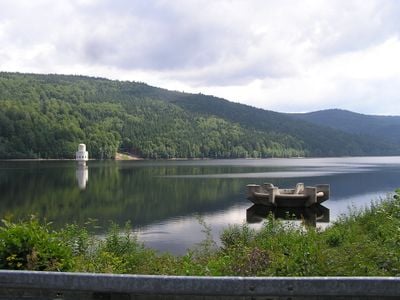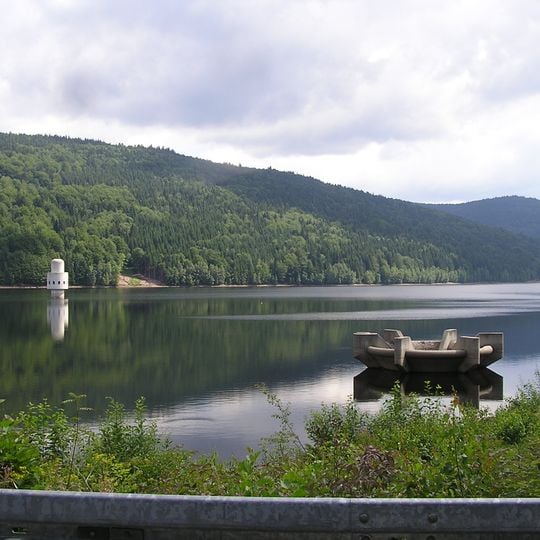
Frauenau Dam, Drinking water reservoir in Bavaria, Germany.
The Frauenau Dam functions as a concrete drinking water reservoir facility designed to supply reliable fresh water to local communities throughout the Bavarian Forest region.
Built between 1976 and 1984 to plans by the Deggendorf water authority, the dam was commissioned in autumn 1984 by Bavarian interior minister Karl Hillermeier. Groundwater shortages in the Bavarian Forest had caused water emergencies in the 1950s and 1960s, and district administrator Max Binder pushed the project through preliminary studies from 1970 to 1975. Regen was already supplied in summer 1983; three workers died during construction.
The reservoir is fed by the Kleiner Regen and Hirschbach, which rise in the unsettled border country between Falkenstein and Rachel. Its catchment lies in a drinking water protection zone, and up to 15 million m³ a year go to the Zweckverband Fernwasserversorgung Bayerischer Wald, serving seven Lower Bavarian districts. The water is treated at the Flanitz plant and distributed through a 900 km network.
The reservoir lies in a completely forested, unsettled area between Frauenau and Zwiesel; the dam crest is reached via a road network built from 1976. The intake tower stands in the water and is visible from the shore. The catchment area is a drinking water protection zone, so access and activity near the water are restricted.
The dam won the 1985 Architekturpreis Beton (Concrete Architecture Prize). Its intake tower, the small domed structure visible in the water, supplies up to 15 million m³ a year to the Fernwasserversorgung Bayerischer Wald, a network serving seven Lower Bavarian districts through 900 km of pipes.
The community of curious travelers
AroundUs brings together thousands of curated places, local tips, and hidden gems, enriched daily by 94,080 contributors worldwide.