Wallfahrtskirche, Catholic pilgrimage church in Zellingen, Germany
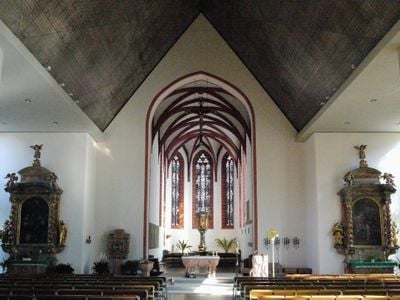
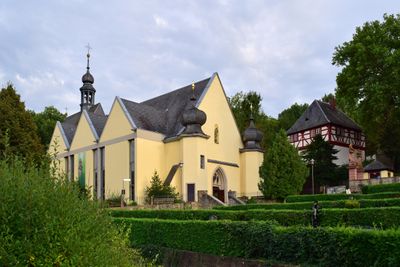
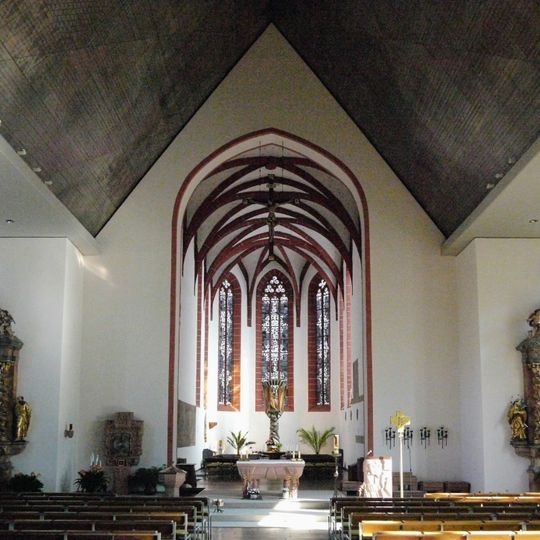
Maria im Grünen Tal is a pilgrimage church in Retzbach, a district of Zellingen. Its oldest part is the Gothic east choir of the 1336 chapel, with a cross-ribbed vault; the nave was rebuilt in 1968–1969 in reinforced concrete after its roof collapsed. The west gable with the 1651 main portal and two Baroque stair towers with onion domes was preserved. The interior has a dark coffered ceiling, white walls, and a pointed chancel arch with red ribs.
A chapel existed by 1202, when the Ravensburg family is said to have founded it after the murder of Bishop Konrad von Querfurt. The Gothic east choir of 1336 survives from the original chapel; the nave was built 1622–1625, and in 1741 the choir's roof turret collapsed, replaced by the present Baroque turret. The nave was enlarged and restuccoed in 1771. Closed as unsafe on 19 May 1968, its roof fell in during a storm that June; Hans Schädel rebuilt the nave at double size in 1968–1969, keeping the 1651 west gable, and Bishop Josef Stangl consecrated it on 13 September 1969.
The name Maria im Grünen Tal, "Mary in the Green Valley", refers to the site in the valley below Retzbach. A legend tells that the lords of Thüngen found the Marian statue with a scratch on its face while digging out a hunted hare from its burrow. Pilgrimages concentrate in September, and behind the church the Marienbrünnle spring draws visitors who fill canisters and bottles with its water.
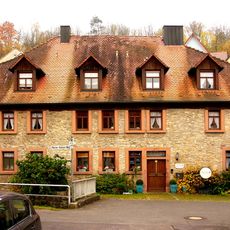
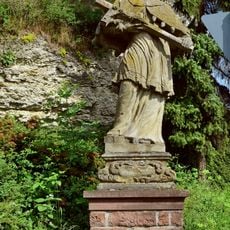
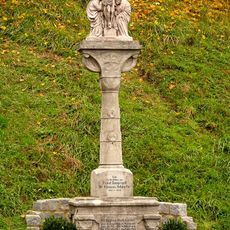
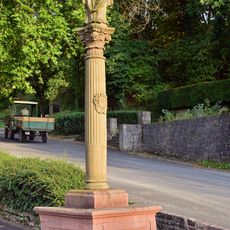
The church stands in Retzbach, reached from the village over an old arched bridge past the parish house and cemetery, where a Marian column of 1698 greets pilgrims. A gate with sandstone statues of Christ and Mary leads to the forecourt; the entrance steps were renewed in 2000 and a wheelchair ramp added. Behind the church is the Marienbrünnle spring, where visitors fill canisters and bottles.
Behind the church lies the Marienbrünnle, a spring whose water is credited with healing power; visitors fill canisters and bottles there. A sandstone relief of the praying Mother of God is set into the shrine. On the north side, the pilgrimage square holds a transportable open-air altar with a roof and a 1981 replica of a crucifixion group whose original stands in Memmelsdorf.
The community of curious travelers
AroundUs brings together thousands of curated places, local tips, and hidden gems, enriched daily by 95,039 contributors worldwide.