Stift Sinsheim, Benedictine monastery in Sinsheim, Germany
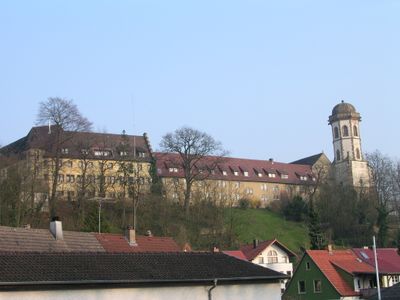
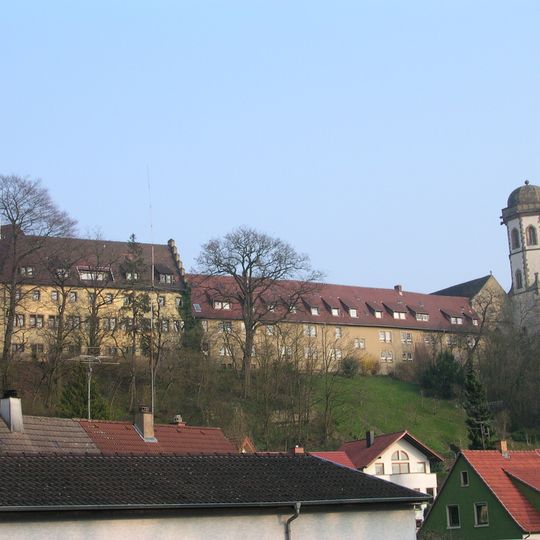
Stift Sinsheim stands on the Michaelsberg above Sinsheim, its main range a two-storey building with a pale yellow facade and rows of small rectangular windows under a steep red tiled roof with dormer windows. To the right the range ends in a square light grey stone tower topped by a dark domed cupola and finial. The church, a three-nave pillar basilica on the foundations of an earlier church, keeps a roof frame dated to 1233.
Count Otto von Worms founded this religious community around 1000, which developed into a Benedictine monastery between 1092 and 1100. This transformation shifted the institution toward monastic life and spiritual practice.
The Stiftskirche, whose core dates to the 10th century, was rebuilt as a cultural centre between 2009 and 2011 and is now run by the Rhein-Neckar-Kreis. Its roof truss timbers in the eastern section were dated by dendrochronology to 1233, and the eaves cornice carries pairs of turned half-moons, the mason's mark of the Maulbronn Paradiesmeister. The name Stift Sunnisheim survives from the children's institution founded in 1887.
The Stiftskirche on the Michaelsberg was converted into a cultural centre between 2009 and 2011 and now hosts concerts, exhibitions and theatre performances. The remaining buildings belong to the Stift Sunnisheim, a youth welfare institution run by the Rhein-Neckar-Kreis, so those parts are not open to visitors. Approach the complex from the town below; the church is the building with the roof frame dated 1233.
Excavations in 2009 uncovered burials and cemetery evidence dating before 1000, revealing that people lived and died here long before the monastery was built. These discoveries show the site held human activity for centuries before its religious transformation.
The community of curious travelers
AroundUs brings together thousands of curated places, local tips, and hidden gems, enriched daily by 93,845 contributors worldwide.