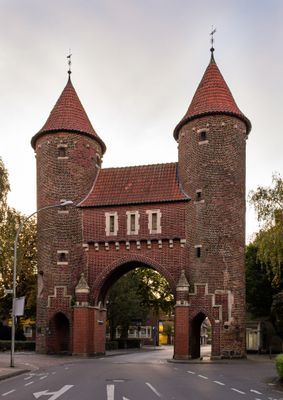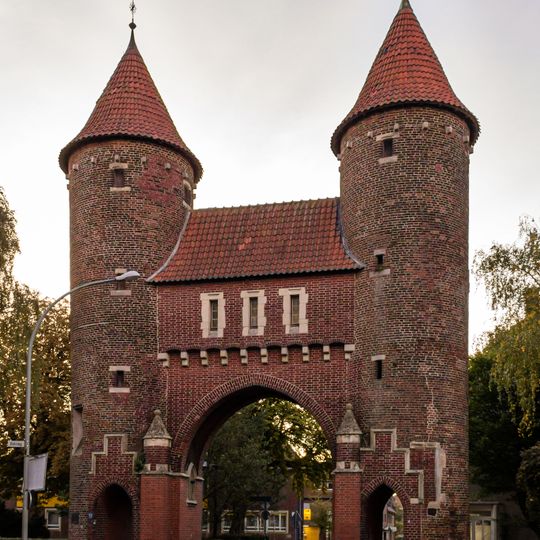
Lüdinghauser Tor, Medieval city gate in Dülmen, Germany
The Lüdinghauser Tor is a city gate with two stone towers connected by a central building, marking the southern entrance to Dülmen's historic center. The structure shows different construction phases and contains passage routes through both towers to handle traffic flow.
The structure started as a wooden building in the 14th century and was transformed into stone in the 15th century, with a central section added in 1911. This development shows how Dülmen modernized its defenses and how the city changed over the centuries.
The gate served as a key crossing point where merchants and travelers paid tolls, making it central to the city's economic life. Today it stands as a symbol of Dülmen's medieval past and reminds visitors of how important this location was to urban activity.
The gate sits directly on Lüdinghauser Street and remains an important pedestrian route and traffic point in the city. The integrated passages allow easy movement through the structure, so visitors can explore the gate without difficulty.
Between 1938 and 1945, the gate replaced a traditional cloverleaf cross as Dülmen's official symbol, showing its importance as a city landmark. This role demonstrated how the structure shaped the city's identity beyond its architectural function.
The community of curious travelers
AroundUs brings together thousands of curated places, local tips, and hidden gems, enriched daily by 60,000 contributors worldwide.