Tausendjährige Eiche, Pedunculate oak, natural monument in Nagel, Küps, Germany
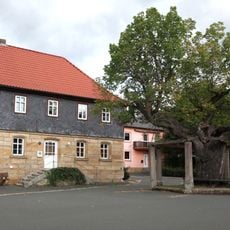
The Tausendjährige Eiche is a pedunculate oak standing on a steep slope by the outer fence of Schloss Alte Kemenate in Nagel, part of the market town of Küps in Upper Franconia. Its bark projects in boards up to ten centimetres thick, with deep grooves running to the top of the crown. The straight trunk rises about 15 metres without branching, and the high-set crown reaches roughly 27 metres in height and 25 metres across.
The oak was designated a natural monument in 1936 under the Reich Nature Protection Act. Its site is said to have been an old Germanic thingstead, where four oaks once stood aligned to the cardinal points. In March 2020 it became the fourth tree added to Germany's list of National Heritage Trees.
The oak stands where four oaks are said to have once grown, aligned with the four cardinal points at equal distances, on what may have been an old Germanic thing site. An old trade and military road, the Berlin–Munich route corresponding today to the B 173, passes nearby, which supports this reading.
The location sits near Schloss Nagel and is accessible through paths that circle the grounds. The tree stands in the open and can be visited at any time of year, with early morning or late afternoon offering the best light for viewing.
The oak was hit by cannon fire during the Swedish siege of the castle in the Thirty Years' War; lead balls and bolts from that bombardment are still lodged in its wood. General Lennart Torstensson besieged the castle for several months without success.
The community of curious travelers
AroundUs brings together thousands of curated places, local tips, and hidden gems, enriched daily by 93,359 contributors worldwide.