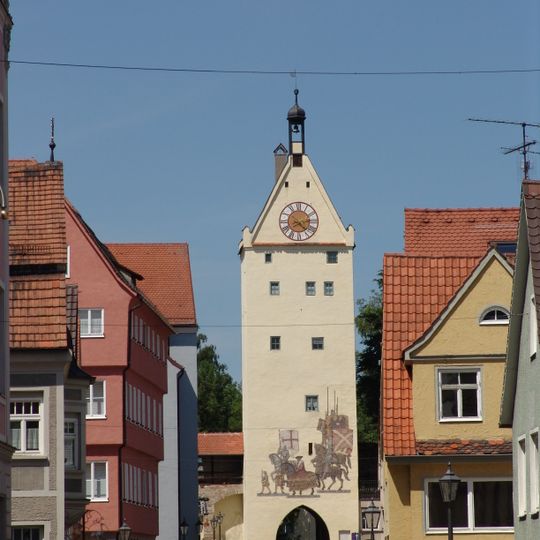
Ulmer Tor, Medieval gate in Memmingen, Germany.
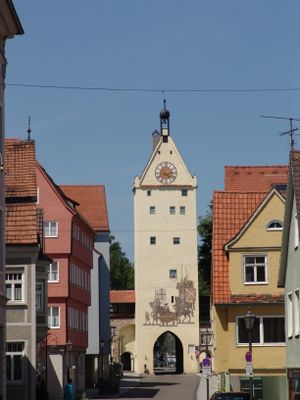
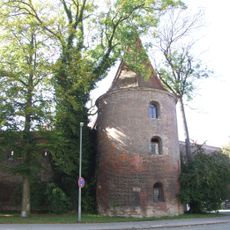
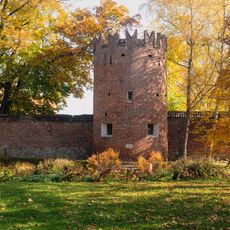
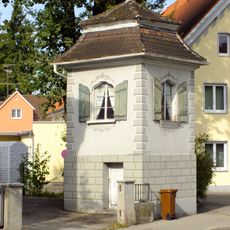
Ulmer Tor is a medieval city gate on the north side of Memmingen with a narrow structure and saddle roof. Sections of the former defensive walkway remain visible, and the passage still connects the historic center to modern neighborhoods.
Around 1400 a new suburb, the Ulmer Vorstadt, grew north of Memmingen; after it was walled, the Ulmer Tor became its northern exit gate, and the tower was completed in 1445. In 1489 Maximilian I entered his imperial city through it with a large retinue. During the Peasants' War the Upper Swabian band came through the gate with 900 men, and in 1630 Wallenstein was led through it to the Fuggerbau. The gate's closure fell in 1821, after which the drawbridge and wooden doors were removed.
The gate displays a painted clock and imperial eagle on its north side, both still visible today. Inside, wall paintings recall the entry of Emperor Maximilian I, a moment that held significance for the city.
The gate is easy to access, located directly on the north side of the city center and reachable on foot. You can view the structure from both sides and gain a good sense of the original city defenses without any special preparation.
The gate witnessed the entry of the Upper Swabian peasants who drafted the Twelve Articles, an early document advocating for human rights. This historical event makes the location a symbol of early demands for equality and justice.
The community of curious travelers
AroundUs brings together thousands of curated places, local tips, and hidden gems, enriched daily by 94,629 contributors worldwide.