Trimburg, Medieval castle ruin in Elfershausen, Germany
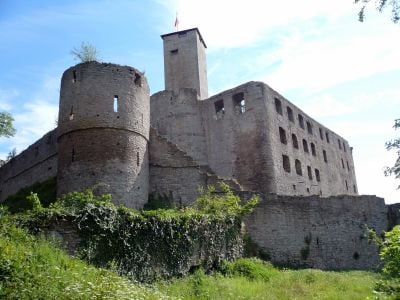
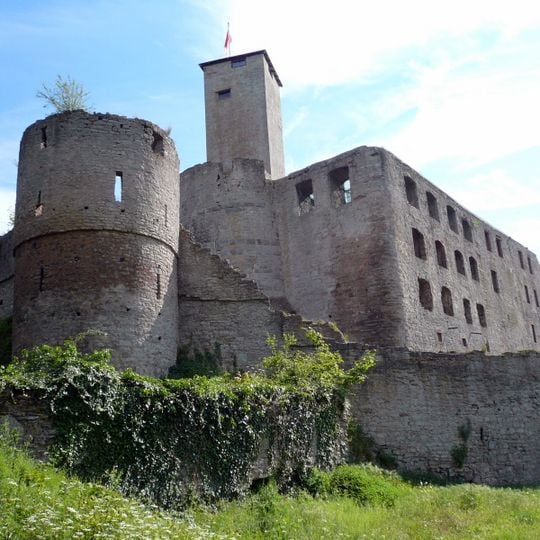
Trimburg is a castle ruin on the Pfaffenberg hill above the Fränkische Saale, built of Buntsandstein. Its surviving parts are the round tower, a square tower with a flat roof and flagpole, and long walls with rows of small rectangular and arched openings; ivy covers the lower wall.
Gozzwin von Trimberg began the oldest part in 1135; it was already called Alte Burg by 1187. Around 1200 the castle was extended westwards with a bergfried and ring wall, reusing stone from the older buildings. In 1525 Kissingen and Euerdorf peasants took and destroyed it, and Bishop Julius Echter had it largely rebuilt in 1592. Sold for demolition after 1803, it became a ruin; from 1833 King Ludwig I halted the decay.
The name derives from the Lords of Trimberg, first documented in a 1018 marriage deed when Anna von Trimberg wed Reinhard von Hohenburg. The family died out with Arrois von Trimberg on 4 November 1384, after which the castle passed to the Prince-Bishopric of Würzburg. Below the southern ring wall, wine has long been grown; yields fell in the 1970s–1990s but are rising again.
A steep, direct stairway leads up from Trimberg village to the ruin at 260 m above sea level; drivers use the signposted access road slightly east of the village to a car park near the castle. The A7 motorway passes two kilometres west, with the Hammelburg interchange linking it to the B287 in the valley.
The ruin visible today is only the last-built part of a complex that once held three separate castles. Gozzwin von Trimberg began the oldest in 1135; by 1187 it was already called the Alte Burg, and its stone was later reused for the western ring wall and bergfried.
The community of curious travelers
AroundUs brings together thousands of curated places, local tips, and hidden gems, enriched daily by 93,359 contributors worldwide.